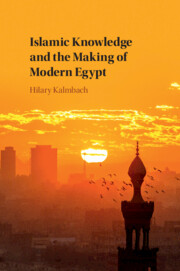

This historical study transforms our understanding of modern Egyptian national culture by applying social theory to the history of Egypt's first teacher-training school. It focuses on Dar al-Ulum, which trained students from religious schools to teach in Egypt's new civil schools from 1872. During the first four decades of British occupation (1882-1922), Egyptian nationalists strove to emulate Europe yet insisted that Arabic and Islamic knowledge be reformed and integrated into Egyptian national culture despite opposition from British officials. This reinforced the authority of the alumni of the Dar al-Ulum, the daramiyya, as arbiters of how to be modern and authentic, a position that graduates Hasan al-Banna and Sayyid Qutb of the Muslim Brotherhood would use to resist westernisation and create new modes of Islamic leadership in the 1930s, 40s and 50s. Establishing a 130-year history for tensions over the place of Islamic ideas and practices within modernized public spaces, tensions which became central to the outcomes of the 2011 Arab Uprisings, Hilary Kalmbach demonstrates the importance of Arabic and Islamic knowledge to notions of authority, belonging, and authenticity within a modernising Muslim-majority community.
‘A meticulously researched study examining the often-conflicting positions regarding what role Islam can play in the construction of a modern society where educational politics and programmes have been key battlegrounds. Based on close-readings of a variety of material and the use of a scale that brings in individuals, social movements as well as institutions, this is a valuable resource for the study of Islam and education, the relation between state-run projects and grass-root movements and, not least, the force with which claims of authenticity can be used in political mobilization.'
Catharina Raudvere - University of Copenhagen
‘Hilary Kalmbach illuminates a critical hybrid pathway to modernity between al-Azhar and the civil schools - the teacher’s college of Dar al-Ulum. That future Muslim Brothers Hasan al-Banna and Sayyid Qutb studied there underlines its significance for understanding Islamic revival movements from the 1930s to the present, in Egypt and around the world.’
Donald M. Reid - University of North Carolina, Chapel Hill
Loading metrics...
* Views captured on Cambridge Core between #date#. This data will be updated every 24 hours.
Usage data cannot currently be displayed.
This section outlines the accessibility features of this content - including support for screen readers, full keyboard navigation and high-contrast display options. This may not be relevant for you.
Accessibility compliance for the PDF of this book is currently unknown and may be updated in the future.
