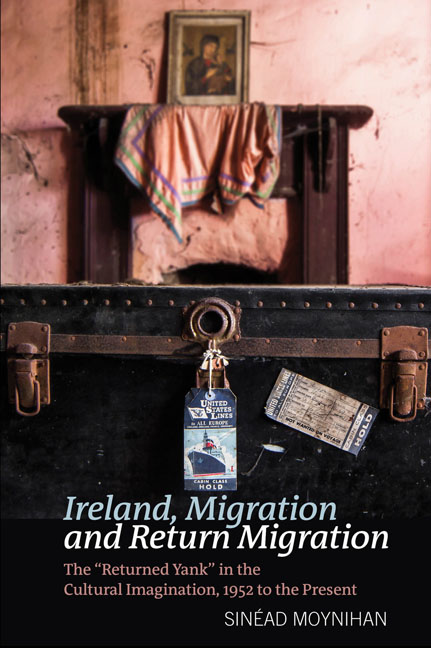
Ireland, Migration and Return Migration

-
The digital format of this book is no longer available to purchase from Cambridge Core. Other formats may be available.
-
Select format
-
- Publisher:
- Liverpool University Press
- Publication date:
- 03 July 2020
- 08 March 2019
- ISBN:
- 9781786949707
- 9781786941800
- Dimensions:
- Weight & Pages:
- Dimensions:
- Weight & Pages:
- Subjects:
- Literature, Literary Theory
You may already have access via personal or institutional login- Subjects:
- Literature, Literary Theory
Show more authors 
You may already have access via personal or institutional login
Book description
Drawing on historical, literary and cultural studies perspectives, this book examines the phenomenon of the 'Returned Yank' in the cultural imagination, taking as its point of departure the most exhaustively discussed Returned Yank narrative, The Quiet Man (dir. John Ford, 1952). Often dismissed as a figure that embodies the sentimentality and nostalgia of Irish America writ large, this study argues that the Returned Yank's role in the Irish cultural imagination is much more varied and complex than this simplistic construction allows. Throughout the twentieth century and into the twenty-first, s/he has been widely discussed in broadcast and print media, and depicted in plays, novels, short stories and films. The imagined figure of the Returned Yank has been the driving impetus behind some of Ireland's most well-known touristic endeavours and festivals. In the form of U.S. Presidential visits, s/he has repeatedly been the catalyst for questions surrounding Irish identity. Most significantly, s/he has been mobilised as an arbiter in one of the most important debates in post-Independence Ireland: should Ireland remain a traditional" society or should it seek to modernise? His/her repeated appearances in Irish literature and culture after 1952 – in remarkably heterogeneous, often very sophisticated ways – refute claims of the 'aesthetic caution' of Irish writers, dramatists and filmmakers responding to the tradition/modernity debate.
Contents
Contents
Metrics
Full text views
Full text views helpTotal number of HTML views: 0
Total number of PDF views: 0 *
 Loading metrics...
* Views captured on Cambridge Core between #date#. This data will be updated every 24 hours.
Usage data cannot currently be displayed.
Accessibility standard: Unknown
Why this information is here
This section outlines the accessibility features of this content - including support for screen readers, full keyboard navigation and high-contrast display options. This may not be relevant for you.
Accessibility Information
Accessibility compliance for the PDF of this book is currently unknown and may be updated in the future.