
Skip to main content Accessibility help
×
  • Cited by 10
    • Show more authors
    • Open Access
      You have digital access to this book
    • Select format
    • Publisher:
      Cambridge University Press
      Publication date:
      15 June 2023
      29 June 2023
      ISBN:
      9781009184175
      9781009184182
      9781009184199
      Creative Commons:
      Creative Common License - CC Creative Common License - BY Creative Common License - NC
      This content is Open Access and distributed under the terms of the Creative Commons Attribution licence CC-BY-NC 4.0.
      https://creativecommons.org/creativelicenses
      Dimensions:
      (229 x 152 mm)
      Weight & Pages:
      0.84kg, 492 Pages
      Dimensions:
      (229 x 152 mm)
      Weight & Pages:
      0.7kg, 492 Pages
    Open Access
    You have digital access to this book
    Selected: Digital
    View content
    Add to cart View cart Buy from Cambridge.org

    Book description

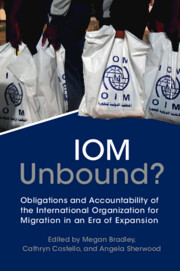
    It is an era of expansion for the International Organization for Migration (IOM), an increasingly influential actor in the global governance of migration. Bringing together leading experts in international law and international relations, this collection examines the dynamics and implications of IOM's expansion in a new way. Analyzing IOM as an international organization (IO), the book illuminates the practices, obligations and accountability of this powerful but controversial actor, advancing understanding of IOM itself and broader struggles for IO accountability. The contributions explore key, yet often under-researched, IOM activities including its role in humanitarian emergencies, internal displacement, data collection, ethical labour recruitment, and migrant detention. Offering recommendations for reforms rooted in empirical evidence and careful normative analysis, this is a vital resource for all those interested in the obligations and accountability of international organizations, and in the field of migration. This title is also available as Open Access on Cambridge Core.

    Reviews

    ‘For me, the IOM was always an international organization lurking in the background, always part of the crowd but never really big or interesting enough to warrant too much attention. Over the last decade it has accumulated greater status - alongside considerable mystery regarding its history, accomplishments, ambitions, legal obligations, and moral compass. Will it become another international organization prepared to do the bidding of the major powers and try and contain migration?  Or will it become a needed voice in the fight for the rights and protection of the growing number of global migrants? This necessary volume puts into tension the practice and ethics, the retrospective and prospective, in fascinating ways.’

    Michael Barnett - University Professor of International Affairs and Political Science, George Washington University

    ‘Global migration governance is rapidly evolving. In the 2018 Global Compact for Migration, 152 States have agreed upon a long-term program for ‘facilitating mobility’, which runs contrary to what most States are currently doing. IOM has come to the light as a major player in this transformation and its oft-heralded positioning as a 'non-normative' service organisation is being challenged. This collection vividly captures the moment when discreet efforts over the past decades come to fruition and IOM is starting to recognise and embrace its new responsibilities, particularly, despite resistance by many States, towards migrants themselves.’

    François Crépeau - Hans & Tamar Oppenheimer Professor of Public International Law, McGill University, former UN Special Rapporteur on the Human Rights of Migrants

    ‘To what extent is an international organization without a protection mandate obliged and able to act in accordance with international human rights? And how can such an organization be held accountable if it defies protection standards? These questions are highly relevant to IOM and its work with migrants, internally displaced persons, and refugees. The contributions in this highly topical book, which innovatively combines scholarship in the field of international law and international relations, provide often unexpected answers for readers interested in the work of the IOM as well as for those studying international organizations more generally.’

    Walter Kälin - Professor Emeritus of law, University of Bern, former Representative of the UN Secretary-General on the Human Rights of Internally Displaced Persons

    ‘IOM Unbound? is an essential guide to understanding the ‘new’, post-2016 IOM. In its well-chosen and well-integrated chapters, leading scholars unpack the extent of change in IOM following its entrance into the 'UN system' as a related agency. They explore the institution's experience as norm-breaker, taker and (potentially) maker in deeply researched explorations of the institution's legal obligations, accountability mechanisms, and record of expansion. This volume will be essential reading for both experts in international migration and general readers interested in exploring the dynamics of global governance.’

    Michael Doyle - University Professor, School of Public and International Affairs, Columbia University

    ‘For too long the International Organization for Migration (IOM) has remained in the shadows of analyses from specialists in international relations and international law. The contributors have asked honest questions and are seeking honest answers about one of the least well-known institutions of global migration governance.  Having only recently become ‘related’ to the United Nations system, this remarkable set of essays about the IOM knits together essential insights from social science and law that scholars and practitioners alike require to understand the growing membership, staff, and budgets, along with the increasing power and presence of this unusual international organization. The critical but constructive chapters are essential to comprehend the past, present, and future of this entrepreneurial and service-driven agency that seeks to alleviate the seemingly ever-growing presence worldwide of refugees and internally displaced persons.’

    Thomas G. Weiss - Presidential Professor of Political Science, CUNY Graduate Center

    ‘This significant and timely collection provides unparalleled insights into the structure, operation, and accountability of IOM. Through critical normative and empirical analysis by diverse scholars of international law and international relations, the book skilfully charts the evolution of IOM’s mandate, practices, and approaches over time. The result is an original and thorough evaluation of IOM’s influence on the global governance of mobility.’

    Jane McAdam AO - Scientia Professor of Law, University of New South Wales

    ‘This outstanding book delivers a sophisticated account of the history, law, and politics of IOM. The authors’ focused attention on this important but overlooked organization yields many broadly applicable insights and lessons, especially on the still-pressing issue of accountability of international organizations.’

    Kristina Daugirdas - Professor of Law, University of Michigan

    ‘The individual contributions fill important gaps in the scholarly analysis of the IOM and provide information on the need for further research for the further development of the organization.’

    Ekkehard Strauß Source: Vereinte Nationen

    Refine List

    Actions for selected content:

    Select all | Deselect all
    • View selected items
    • Export citations
    • Download PDF (zip)
    • Save to Kindle
    • Save to Dropbox
    • Save to Google Drive

    Save Search

    You can save your searches here and later view and run them again in "My saved searches".

    Please provide a title, maximum of 40 characters.
    ×

    Contents

    Full book PDF
    • IOM Unbound?
      pp i-ii
    • Copyright page
      pp iv-iv
    • Contents
      pp v-vi
    • Contributors
      pp vii-x
    • Foreword
      pp xi-xiii
    • Acknowledgements
      pp xiv-xv
    • Table of Cases
      pp xvi-xvii
    • Table of Statutes and Treaties
      pp xviii-xix
    • Abbreviations and Acronyms
      pp xx-xxiv
    • Part I - IOM’s Mandate, Structure, and Relationship with the UN
      pp 43-184
    • 2 - Who and What Is IOM For? The Evolution of IOM’s Mandate, Policies, and Obligations
      pp 45-78
    • 3 - The (Possible) Responsibility of IOM under International Law
      pp 79-100
    • 5 - A Human Rights Due Diligence Policy for IOM?
      pp 137-160
    • Part II - IOM in Action
      pp 185-448
    • 8 - How IOM Reshaped Its Obligations on Climate-Related Migration
      pp 213-234
    • 10 - IOM and Ethical Labour Recruitment
      pp 270-296
    • 11 - The International Organization for Migration in Humanitarian Scenarios
      pp 297-325
    • Index
      pp 449-467

    Metrics

    Altmetric attention score

    Full text views

    Total number of HTML views: 0
    Total number of PDF views: 0 *
    Loading metrics...

    Book summary page views

    Total views: 0 *
    Loading metrics...

    * Views captured on Cambridge Core between #date#. This data will be updated every 24 hours.

    Usage data cannot currently be displayed.

    Accessibility standard: Unknown

    Why this information is here

    This section outlines the accessibility features of this content - including support for screen readers, full keyboard navigation and high-contrast display options. This may not be relevant for you.

    Accessibility Information

    Accessibility compliance for the PDF of this book is currently unknown and may be updated in the future.
