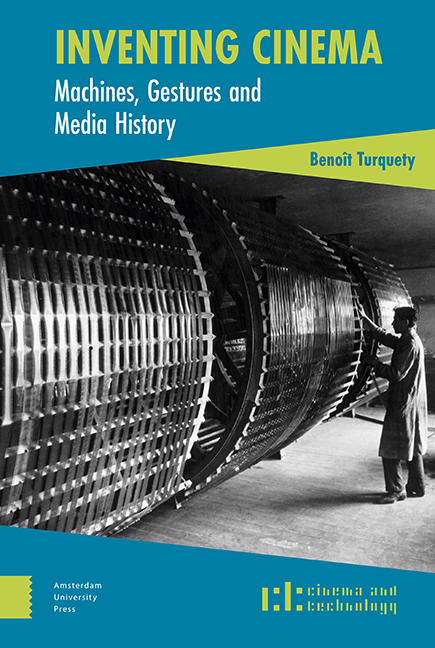

With machines mediating most of our cultural practices, and innovations, obsolescence and revivals constantly transforming our relation with images and sounds, media feel more unstable than ever. But was there ever a ‘stable’ moment in media history? Inventing Cinema proposes to approach this question through an archaeology and epistemology of media machines. The archaeology analyses them as archives of users’ gestures, as well as of modes of perception. The epistemology reconstructs the problems that the machines’ designers and users have strived to solve, and the network of concepts they have elaborated to understand these problems. Drawing on the philosophy of technology and anthropology, Inventing Cinema argues that networks of gestures, problems, perception and concepts are inscribed in vision machines, from the camera obscura to the stereoscope, the Cinématographe, and digital cinema. The invention of cinema is ultimately seen as an ongoing process irreducible to a single moment in history.
Loading metrics...
* Views captured on Cambridge Core between #date#. This data will be updated every 24 hours.
Usage data cannot currently be displayed.
This section outlines the accessibility features of this content - including support for screen readers, full keyboard navigation and high-contrast display options. This may not be relevant for you.
Accessibility compliance for the PDF of this book is currently unknown and may be updated in the future.
