Interrogating Young Suspects II

-
Select format
-
- Publisher:
- Intersentia
- Publication date:
- 21 September 2018
- 04 January 2016
- ISBN:
- 9781780687544
- 9781780683010
- Dimensions:
- Weight & Pages:
- Dimensions:
- Weight & Pages:
- Subjects:
- Law: General Interest, Law
You may already have access via personal or institutional login- Subjects:
- Law: General Interest, Law
Show more authors 
You may already have access via personal or institutional login
Book description
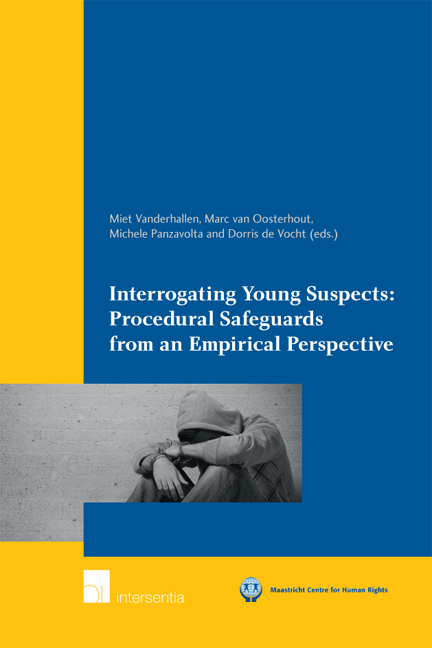
This book is the second of two volumes published in the context of the research project 'Protecting Young Suspects in Interrogations'. This EU-funded research project sprung from the observation that knowledge of the existing level of procedural protection offered to juvenile suspects during interrogation is limited. The research project aimed to fill at least part of this gap by shedding more light on the existing procedural rights for juveniles during interrogations in five EU Member States with different systems of juvenile justice (Belgium, England and Wales, Italy, Poland and the Netherlands). In doing so, it intended to identify legal and empirical patterns to improve the effective protection of the juvenile suspect. The project has been a joint effort of Maastricht University, Warwick University, Antwerp University, Jagiellonian University and Macerata University in cooperation with Defence for Children and PLOT Limburg. The results of the first part of the project - a legal and comparative study into existing legal procedural safeguards for juvenile suspects during interrogation in the five selected Member States - have been published in a separate volume (M. Panzavolta, D. de Vocht, M. van Oosterhout and M. Vanderhallen, Interrogating Young Suspects: Procedural Safeguards from a Legal Perspective, Cambridge: Intersentia 2015). This second volume reflects the results of the second and third part of the research project. First, it contains the results of the empirical research conducted in the five Member States consisting of focus group interviews and observations of recorded interrogations. The empirical findings of each Member State are discussed in separate chapters to provide an in-depth account of perceptions and practices in the context of each jurisdiction. Second, the country reports are followed by an integrated analysis resulting from the merging of the legal and empirical findings offering a comparative overview and combining the national findings into an integrated perspective. Finally, the book contains a set of guidelines - a framework of minimum rules - developed on the basis of the research project's findings. The guidelines and their additional explanatory remarks include recommendations for good practices and are intended to serve as an inspiration for promoting good practice in the context of juvenile suspect interrogations throughout the EU. The book is intended for practitioners, academics, researchers and policy-makers working in the area of juvenile justice and interrogation.
Contents
Contents
Metrics
Full text views
Full text views helpTotal number of HTML views: 0
Total number of PDF views: 0 *
 Loading metrics...
* Views captured on Cambridge Core between #date#. This data will be updated every 24 hours.
Usage data cannot currently be displayed.
Accessibility standard: Unknown
Why this information is here
This section outlines the accessibility features of this content - including support for screen readers, full keyboard navigation and high-contrast display options. This may not be relevant for you.
Accessibility Information
Accessibility compliance for the PDF of this book is currently unknown and may be updated in the future.