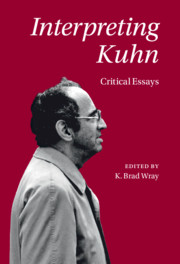

Interpreting Kuhn provides a comprehensive, up-to-date study of Thomas Kuhn's philosophy and legacy. With twelve essays newly written by an international group of scholars, it covers a wide range of topics where Kuhn had an influence. Part I deals with foundational issues such as Kuhn's metaphysical assumptions, his relationship to Kant and Kantian philosophy, as well as contextual influences on his writing, including Cold War psychology and art. Part II tackles three Kuhnian concepts: normal science, incommensurability, and scientific revolutions. Part III deals with the Copernican Revolution in astronomy, the theory-ladenness of observation, scientific discovery, Kuhn's evolutionary analogies, and his theoretical monism. The volume is an ideal resource for advanced students seeking an overview of Kuhn's philosophy, and for specialists following the development of Kuhn scholarship.
‘This collection sits at a perfect academic sweet spot: it is an excellent resource for advanced students and researchers who want to quickly get up to speed on the current state of the literature on Kuhn (1922–96), and it contributes meaningfully and importantly to the history of science … Required reading for scholars of the philosophy of science … Essential.’
R. C. Robinson Source: Choice Connect
Loading metrics...
* Views captured on Cambridge Core between #date#. This data will be updated every 24 hours.
Usage data cannot currently be displayed.
This section outlines the accessibility features of this content - including support for screen readers, full keyboard navigation and high-contrast display options. This may not be relevant for you.
Accessibility compliance for the PDF of this book is currently unknown and may be updated in the future.
