
- Publisher:
- Cambridge University Press
- Online publication date:
- March 2024
- Print publication year:
- 2024
- Online ISBN:
- 9781009355025
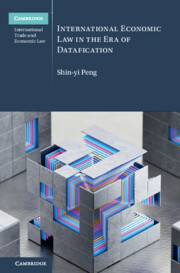
This book addresses the challenges of datafication through the lens of international economic law. We are undergoing a wave of datafication practices. If such practices simply continue to evolve without being examined and repaired along the existing path of development, the same issues will continue to accumulate and will more than likely be amplified. The unprecedented economic and social influence of big tech has served as the catalyst for the concept of 'digital sovereignty,' which is rooted in the need to safeguard regulatory autonomy in a datafied world. The current wave of data-driven innovations has placed the policy debates on digital trade and data governance into an even more challenging context. The book – whose chapters are connected by the many facets of 'data' - systematically explains how international economic law can reduce the perils of datafication instead of enhancing them. This title is part of the Flip it Open Programme and may also be available Open Access. Check our website Cambridge Core for details.
‘This timely book takes readers to all the nooks and crannies of one of the most complex and yet transformative frontiers in contemporary trade governance. A must read for anyone seeking answers on where the evolving digital trade rule-book is headed and the forces shaping this global journey. A genuine tour de force!’
Pierre Sauvé - World Bank
‘International Trade Law cannot be adequately understood anymore without comprehending datafication. Shin-yi Peng wrote a master piece on the dynamic interplay between datafication and international trade treaties, covering inter alia national security, data protection, competition policy, and privacy and free speech, analyzing both, pitfalls and promises. It is a must-read for anyone interested in the future of international trade.’
Anne van Aaken - Alexander von Humboldt Professor for Law and Economics, Legal Theory, Public International Law and European Law, University of Hamburg
‘This book provides a magisterial analysis of datafication. An expert on trade in services, Peng explains how increasing digital inclusion may paradoxically expose people to both the benefits and the costs of increasing datafication. She offers an optimistic account of how international economic law can be reformed to better promote data-related policy objectives ranging from national security to culture.’
Tania Voon - Professor and Director of International Economic Law Studies, University of Melbourne Law Schoo
 Loading metrics...
* Views captured on Cambridge Core between #date#. This data will be updated every 24 hours.
Usage data cannot currently be displayed.