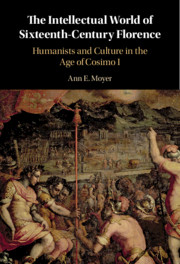

By the sixteenth century, Florence was famous across Europe for its achievements in the arts, letters, and humanist learning. Its intellectual life flourished anew at midcentury with Duke Cosimo and the Accademia Fiorentina. In this study, Ann Moyer provides an overview of Florentine intellectual life and community in the late Renaissance. She shows how studies of language helped Florentines develop their own story as a people distinct from ancient Greece or Rome, trace the rise of the city's medieval government, and explore how the city evolved into a hospitable environment for letters and the arts. Studies of Florentine art gave rise to art history, while those devoted to Florentine traditions and customs inspired broader questions about how to think about cultural change. Demonstrating how the intellectual activity around language, history, and art related and supported each other, Moyer's book documents the origins of the modern narrative of the Renaissance itself.
‘… an extremely learned and well-informed account of high culture in Florence under Cosimo I. It is to be hoped that her findings and deep erudition will generate further research, extending the chronological analysis both before and after the reign of the first Medicean grand duke.’
Robert D. Black Source: Journal of Modern History
Loading metrics...
* Views captured on Cambridge Core between #date#. This data will be updated every 24 hours.
Usage data cannot currently be displayed.
This section outlines the accessibility features of this content - including support for screen readers, full keyboard navigation and high-contrast display options. This may not be relevant for you.
Accessibility compliance for the PDF of this book is currently unknown and may be updated in the future.
