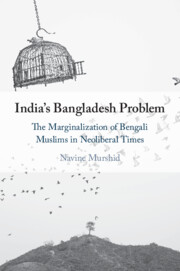
India's Bangladesh Problem

-
Select format
-
- Publisher:
- Cambridge University Press
- Publication date:
- 30 March 2023
- 06 April 2023
- ISBN:
- 9781009259392
- 9781009259422
- 9781009259408
- Dimensions:
- (229 x 152 mm)
- Weight & Pages:
- 0.55kg, 288 Pages
- Dimensions:
- (229 x 152 mm)
- Weight & Pages:
- 0.42kg, 288 Pages
You may already have access via personal or institutional login
Show more authors 
You may already have access via personal or institutional login
Book description
In recent years, Bengali Muslims in India have faced harassment and scapegoating as the trope of the illegal Bangladeshi has gained political currency. India's Bangladesh Problem explores the experience of Bengali Muslims on the Indian side of the India–Bangladesh border in the context of neoliberal policies, unequal bilateral relations, labor migration, contested citizenship, and increasingly xenophobic government rhetoric. Drawing on extensive research in the borderlands and hinterlands of both countries, Navine Murshid argues that ever-deepening neoliberal policies across the border have shaped how certain ethnic groups are valued and have reconfigured social hierarchies. She provides new insights into the strategic inclusion, exclusion, and invisibility that characterizes Bengali Muslims' lives, rendering them a group susceptible to manipulation by virtue of their ethnic kinship to the majority of Bangladeshis. In turn, Bengali Muslims simultaneously resist and utilize received neoliberal ideas to sustain their lives and livelihoods at a time when neoliberal development has largely bypassed them.
Reviews
‘Navine Murshid has written a very important and timely book on how the Bengali Muslim is imagined, produced, and scapegoated as ‘Bangladeshi’ in India. Combining feminist methodology with fieldwork in West Bengal and Assam, Murshid offers a scathing criticism of the shared neoliberal drive for development between India and Bangladesh, while India isolates the human Bengali Muslim person into a threatening other and invisible citizen.’
Yasmin Saikia - Arizona State University
‘Murshid lays bare the marginalization of Bengali Muslims, Indian and Bangladeshi, in contemporary India-and different forms of resistance to this abjection. Based on deep research of national, state-level, and local interactions, this book compels us to rethink our understanding of neoliberalism, borders, identity, and citizenship in and beyond South Asia.’
Elora Shehabuddin - University of California, Berkeley
Contents
Contents
References
Metrics
Full text views
Full text views helpTotal number of HTML views: 0
Total number of PDF views: 0 *
 Loading metrics...
* Views captured on Cambridge Core between #date#. This data will be updated every 24 hours.
Usage data cannot currently be displayed.
Accessibility standard: Unknown
Why this information is here
This section outlines the accessibility features of this content - including support for screen readers, full keyboard navigation and high-contrast display options. This may not be relevant for you.
Accessibility Information
Accessibility compliance for the PDF of this book is currently unknown and may be updated in the future.