Ilios

-
Select format
-
- Publisher:
- Cambridge University Press
- Publication date:
- 05 August 2011
- 15 July 2010
- ISBN:
- 9780511711572
- Dimensions:
- Weight & Pages:
- Dimensions:
- Weight & Pages:
You may already have access via personal or institutional login
Show more authors 
You may already have access via personal or institutional login
Book description
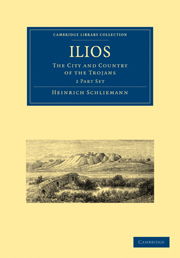
Heinrich Schliemann (1822–1890) was a businessman and self-taught archaeologist who is best known for discovering the site of the ancient city of Troy. First published in 1880, this volume contains an account of Schliemann's second excavation at Troy in 1878–1879 and places his earlier discoveries from the excavations of 1871–1873 in context with his more recent work. Schliemann provides a detailed description and the earliest interpretation of the seven settlement phases on the site, with over 1,000 illustrations showing details of the architecture he uncovered. He also describes his controversial methods of excavation, recounting some of the monumental buildings he destroyed to reach the earlier settlement phases of the city. Schliemann's discovery of Troy was met with great enthusiasm; it also created a furious debate over the validity of viewing classical epics as historical fact. This volume remains an important source for the historiography of archaeology.
Metrics
Full text views
Full text views helpTotal number of HTML views: 0
Total number of PDF views: 0 *
 Loading metrics...
* Views captured on Cambridge Core between #date#. This data will be updated every 24 hours.
Usage data cannot currently be displayed.
Accessibility standard: Unknown
Why this information is here
This section outlines the accessibility features of this content - including support for screen readers, full keyboard navigation and high-contrast display options. This may not be relevant for you.
Accessibility Information
Accessibility compliance for the PDF of this book is currently unknown and may be updated in the future.