The Idea of the City in Late Antiquity

-
Select format
-
- Publisher:
- Cambridge University Press
- Publication date:
- January 2025
- February 2025
- ISBN:
- 9781009527118
- 9781009527071
- Dimensions:
- (244 x 170 mm)
- Weight & Pages:
- 1.02kg, 456 Pages
- Dimensions:
- Weight & Pages:
You may already have access via personal or institutional login
Show more authors 
You may already have access via personal or institutional login
Book description
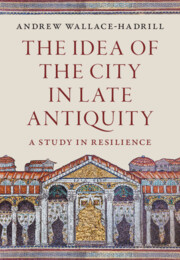
The city was one of the central and defining features of the world of the Greek and Roman Mediterranean. Challenging the idea that the ancient city 'declined and fell', Andrew Wallace-Hadrill argues that memories of the past enabled cities to adapt and remain relevant in the changing post-Roman world. In the new kingdoms in Italy, France and Spain cities remained a key part of the structure of control, while to contemporary authors, such as Cassiodorus in Ostrogothic Italy, Gregory of Tours in Merovingian Gaul, and Isidore in Visigothic Spain, they remained as crucial as in antiquity. The archaeological evidence of New Cities founded in this period, from Constantinople to Reccopolis in Spain, also shows the deep influence of past models. This timely and exhilarating book reveals the adaptability of cities and the endurance of the Greek and Roman world.
Reviews
‘With exciting literary arguments that challenge the assumption of urban ‘decline and fall' in the post-Roman West, Andrew Wallace-Hadrill illuminates the continuous bustle of activity in centres like Seville, Marseille and Ravenna. No seventh century collapse here, but a lively, highly readable story of proud city dwellers adapting to a new medieval world, in what is also an admirable and compelling homage to his father.'
Judith Herrin - King's College London
‘Andrew Wallace-Hadrill's book, The Idea of the City After Antiquity, is a welcome addition to our understanding of the resilience of urban life in the face of the collapse of Roman imperial power in the West. The “idea of the city” is explored primarily through the words of the men who lived into post-Roman times, and mostly in the west. Tracing changes to what it meant to live in a city, even as its physical fabric changed or decayed, opens up new avenues to appreciate the human construction of social, economic and religious life in the post-Roman world Wallace-Hadrill demonstrates that the human dimension – not just the physical remnant – is paramount for anyone interested in urbanism, whether ancient or modern. Scholars as well as students will benefit from reading this finely nuanced study of how late Romans used the idea of the city to restore and recreate new and enduring communities.'
Michele R. Salzman - University of California, Riverside
Contents
Contents
Metrics
Altmetric attention score
Full text views
Full text views helpTotal number of HTML views: 0
Total number of PDF views: 0 *
 Loading metrics...
* Views captured on Cambridge Core between #date#. This data will be updated every 24 hours.
Usage data cannot currently be displayed.
Accessibility standard: Unknown
Why this information is here
This section outlines the accessibility features of this content - including support for screen readers, full keyboard navigation and high-contrast display options. This may not be relevant for you.
Accessibility Information
Accessibility compliance for the PDF of this book is currently unknown and may be updated in the future.