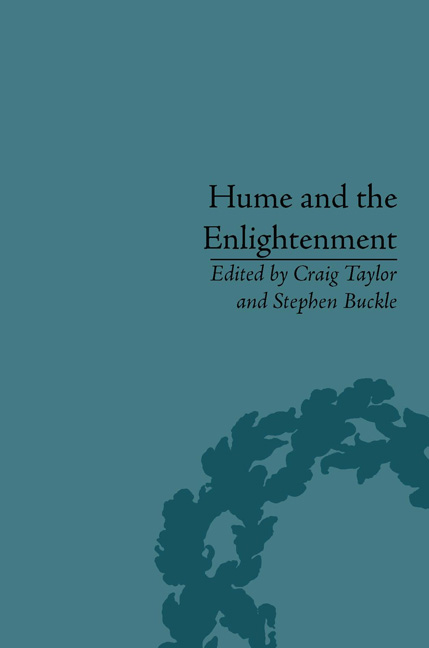
Hume and the Enlightenment

-
The digital format of this book is no longer available to purchase from Cambridge Core. Other formats may be available.
-
Select format
-
- Publisher:
- Pickering & Chatto
- Publication date:
- 05 December 2014
- ISBN:
- 9781848930858
- 9781848930841
- Dimensions:
- Weight & Pages:
- 00kg,
- Dimensions:
- Weight & Pages:
- Subjects:
- Philosophy of Social Science, Philosophy
You may already have access via personal or institutional login- Subjects:
- Philosophy of Social Science, Philosophy
Show more authors 
You may already have access via personal or institutional login
Book description
While Hume remains one of the most central figures in modern philosophy, his place within Enlightenment thinking is much less clearly defined. Although historically an Enlightenment figure, this identity is often missed due to misunderstandings of both his philosophy and of the movement itself. Taking recent work on Hume as a starting point, this volume of original essays aims to re-examine and clarify Hume's influence on the thought and values of the Enlightenment.There are many books on Hume’s philosophy, but few that deal with his influence on Enlightenment thinking and ideas more generally. Indeed, while Hume is now widely regarded as one of the most significant of British philosophers, he was in his day also counted as a weighty essayist and historian. Further, the influences of Hume's empiricism stretch from encouraging the exploration of sentiment in literature to being a forerunner of the new discipline of cognitive science. This volume is a valuable resource to students and researchers seeking to establish what it is that counts as Enlightenment thinking, and whether Hume should really be regarded as a philosopher of the Enlightenment world.
Contents
Contents
Metrics
Full text views
Full text views helpTotal number of HTML views: 0
Total number of PDF views: 0 *
 Loading metrics...
* Views captured on Cambridge Core between #date#. This data will be updated every 24 hours.
Usage data cannot currently be displayed.
Accessibility standard: Unknown
Why this information is here
This section outlines the accessibility features of this content - including support for screen readers, full keyboard navigation and high-contrast display options. This may not be relevant for you.
Accessibility Information
Accessibility compliance for the PDF of this book is currently unknown and may be updated in the future.