
Skip to main content Accessibility help
×
  • Cited by 2
    • Show more authors
    • You may already have access via personal or institutional login
    • Select format
    • Publisher:
      Cambridge University Press
      Publication date:
      18 March 2021
      01 April 2021
      ISBN:
      9781108933421
      9781108844109
      Dimensions:
      (229 x 152 mm)
      Weight & Pages:
      0.5kg, 248 Pages
      Dimensions:
      Weight & Pages:
    You may already have access via personal or institutional login
  • Selected: Digital
    Add to cart View cart Buy from Cambridge.org

    Book description

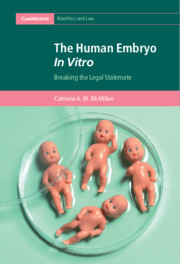
    The Human Embryo in vitro explores the ways in which UK law engages with embryonic processes under the Human Fertilisation and Embryology Act 1990 (as amended), the intellectual basis of which has not been reconsidered for almost thirty years. McMillan argues that in regulating 'the embryo' – that is, a processual liminal entity in itself - the law is regulating for uncertainty. This book offers a fuller understanding of how complex biological processes of development and growth can be better aligned with a legal framework that purports to pay respect to the embryo while also allowing its destruction. To do so it employs an anthropological concept, liminality, which is itself concerned with revealing the dynamics of process. The implications of this for contemporary regulation of artificial reproduction are fully explored, and recommendations are offered for international regimes on how they can better align biological reality with social policy and law.

    Reviews

    ‘Offering a strikingly fresh perspective on the regulation of human embryos, this valuable new book argues persuasively that the law’s attempt to ascribe a single fixed status to ‘the embryo’ is destined to fail, and that we should acknowledge instead the fluid, context-specific and essentially liminal nature of human embryos in vitro.’

    Emily Jackson - Professor of Law, The London School of Economics and Political Science

    ‘Using two innovative lenses - liminality and the gothic - in this book McMillan addresses the place and construction of ‘the embryo’ in law. Her penetrating socio-legal analysis draws on the science and technology studies and anthropological literatures to persuasively argue that there is no singular ‘embryo’ in law, but instead multiple (unacknowledged) ones. Her incisive analysis emphasises the significance of thresholds, boundaries, and processes for understanding law and legal gaps regarding these. She insists that it is ‘time to break the legal stalemate surrounding embryos in vitro’. The book is a call to arms - for both regulators and legal scholars - to take context and process seriously. Readers will be left in no doubt that this is a call we should all heed.’

    Muireann Quigley - Professor of Law, Medicine, and Technology, Birmingham Law School

    Refine List

    Actions for selected content:

    Select all | Deselect all
    • View selected items
    • Export citations
    • Download PDF (zip)
    • Save to Kindle
    • Save to Dropbox
    • Save to Google Drive

    Save Search

    You can save your searches here and later view and run them again in "My saved searches".

    Please provide a title, maximum of 40 characters.
    ×

    Contents

    Metrics

    Altmetric attention score

    Full text views

    Total number of HTML views: 0
    Total number of PDF views: 0 *
    Loading metrics...

    Book summary page views

    Total views: 0 *
    Loading metrics...

    * Views captured on Cambridge Core between #date#. This data will be updated every 24 hours.

    Usage data cannot currently be displayed.

    Accessibility standard: Unknown

    Why this information is here

    This section outlines the accessibility features of this content - including support for screen readers, full keyboard navigation and high-contrast display options. This may not be relevant for you.

    Accessibility Information

    Accessibility compliance for the PDF of this book is currently unknown and may be updated in the future.
