
Skip to main content Accessibility help
×
  • Cited by 2
    • Show more authors
    • You may already have access via personal or institutional login
    • Select format
    • Publisher:
      Cambridge University Press
      Publication date:
      July 2023
      August 2023
      ISBN:
      9781009360005
      9781009359955
      9781009359993
      Dimensions:
      (229 x 152 mm)
      Weight & Pages:
      0.7kg, 386 Pages
      Dimensions:
      (229 x 152 mm)
      Weight & Pages:
      0.57kg, 386 Pages
    You may already have access via personal or institutional login
  • Selected: Digital
    Add to cart View cart Buy from Cambridge.org

    Book description

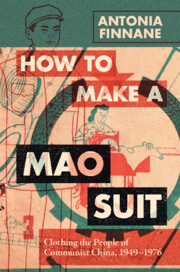
    When the People's Republic of China was founded in 1949, new clothing protocols for state employees resulted in far-reaching changes in what people wore. In a pioneering history of dress in the Mao years (1949–1976), Antonia Finnane traces the transformation, using industry archives and personal stories to reveal a clothing regime pivoted on the so-called 'Mao suit'. The time of the Mao suit was the time of sewing schools and sewing machines, pattern books and homemade clothes. It was also a time of close economic planning, when rationing meant a limited range of clothes made, usually by women, from limited amounts of cloth. In an area of scholarship dominated by attention to consumption, Finnane presents a revisionist account focused instead on production. How to Make a Mao Suit provides a richly illustrated account of clothing that links the material culture of the Mao years to broader cultural and technological changes of the twentieth century.

    Reviews

    ‘Garments made and worn mirror wider societal priorities, possibilities, and constraints. Antonia Finnane brilliantly illuminates the complexity of the Maoist era, a time of seemingly simple and strict sartorial aims, revealed as much more. Finnane recasts our understanding with ground-breaking gender-rich scholarship, revealing the options and boundaries shaping twentieth-century Chinese life.’

    Beverley Lemire - University of Alberta

    ‘The book provides a beautiful read of the centrality of fashion in the construction of citizenship. This is not surprising as the monograph’s significant contribution to the field of research is the juxtaposition of the aesthetic and problematic styles and modes of clothing and their impact on China’s historical knowledge. The poignant book captures the essence and beauty of the Nationalist and Communist eras. Never complicated and filled with astounding images, ‘How to Make a Mao Suit’ employs a youthful artistic expression of style, color, and energy to the establishment of these extraordinary years. This is a book of historical vulnerability and a country’s identity, originality, and individuality. Ultimately, Finnane’s book is an enlivened and aesthetic writing, exploring a socially conscious art form that invades and explodes the powerful nexus of tianxia (under heaven).’

    Xiao Di ‘Janice’ Tong Source: H-Net Reviews

    ‘[This book] provides invaluable teaching material. Its nuanced exploration contributes richly to our understanding of China’s modern history and its global interactions through the lens of ‘a needle and a thread,’ making the book a valuable contribution to the fields of history, economics and cultural studies.’

    Peidong Sun Source: The China Quarterly

    ‘Through close analysis of the sewing tools, sewing schools, and pattern books, the book illustrates how a highly uniform clothing culture centred on the zhifu emerged, all the while giving space to 'strange clothes and outlandish dress,' which did not displace but served to maintain the centrality and prevalence of the zhifu. Personal stories included in the book make it a much more interesting and enjoyable read …’

    Jianhua Zhao Source: China Perspectives

    ‘Finnane’s book will be a fantastically useful resource for researchers on the history of the Chinese clothing and fashion industry, on social and cultural history, on the interface between technological innovation and everyday life, on gender issues in the Republic and the early PRC, and no doubt many other fields of study as well. As readers familiar with Finnane’s work will expect, the book is not just scholarly but also fluently written and highly readable. For her contemporaries, it will also be a trip down memory lane, as we recall the surprising variety of styles of clothing - concealed among apparent uniformity - in the China of the 1970s and 1980s. … a magisterial study.’

    Alison Hardie - Europe-Asia Studies

    Refine List

    Actions for selected content:

    Select all | Deselect all
    • View selected items
    • Export citations
    • Download PDF (zip)
    • Save to Kindle
    • Save to Dropbox
    • Save to Google Drive

    Save Search

    You can save your searches here and later view and run them again in "My saved searches".

    Please provide a title, maximum of 40 characters.
    ×

    Contents

    Metrics

    Altmetric attention score

    Full text views

    Total number of HTML views: 0
    Total number of PDF views: 0 *
    Loading metrics...

    Book summary page views

    Total views: 0 *
    Loading metrics...

    * Views captured on Cambridge Core between #date#. This data will be updated every 24 hours.

    Usage data cannot currently be displayed.

    Accessibility standard: Unknown

    Why this information is here

    This section outlines the accessibility features of this content - including support for screen readers, full keyboard navigation and high-contrast display options. This may not be relevant for you.

    Accessibility Information

    Accessibility compliance for the PDF of this book is currently unknown and may be updated in the future.
