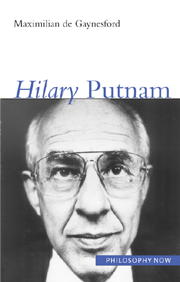

Hilary Putnam is one of the most influential philosophers of recent times, and his authority stretches far beyond the confines of the discipline. He has had a dramatic influence on theories of meaning, semantic content, the nature of mental phenomena, on interpretations of quantum mechanics, theory-change, logic, mathematics, and on what shape we should desire for future philosophy. However, the diversity of Putnam's writings and his frequent spells of radical rethinking pose a considerable challenge to readers. De Gaynesford shows how these difficulties may be overcome by examining the whole of Putnam's career within its historical context in an accurate and accessible way. In so doing he reveals a basic unity in Putnam's work, achieved through repeated engagements with a small set of hard problems. By foregrounding this integrity, the book offers an account that is both true to Putnam and will be welcomed by students and philosophers alike as an aid to reading his work.
"An excellent introduction to Putnam's work, which offers an original encompassing interpretative hypothesis as a guide through this complex corpus of work."
Axel Mueller
Loading metrics...
* Views captured on Cambridge Core between #date#. This data will be updated every 24 hours.
Usage data cannot currently be displayed.
This section outlines the accessibility features of this content - including support for screen readers, full keyboard navigation and high-contrast display options. This may not be relevant for you.
Accessibility compliance for the PDF of this book is currently unknown and may be updated in the future.
