
Skip to main content Accessibility help
×
  • Cited by 35
    • Show more authors
    • You may already have access via personal or institutional login
    • Select format
    • Publisher:
      Cambridge University Press
      Publication date:
      05 March 2014
      06 March 2014
      ISBN:
      9781107110816
      9781107046900
      9781107624979
      Dimensions:
      (216 x 138 mm)
      Weight & Pages:
      0.57kg, 348 Pages
      Dimensions:
      (216 x 140 mm)
      Weight & Pages:
      0.43kg, 348 Pages
    You may already have access via personal or institutional login
  • Selected: Digital
    Add to cart View cart Buy from Cambridge.org

    Book description

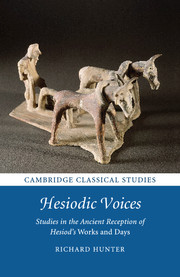
    This book selects central texts illustrating the literary reception of Hesiod's Works and Days in antiquity and considers how these moments were crucial in fashioning the idea of 'didactic literature'. A central chapter considers the development of ancient ideas about didactic poetry, relying not so much on explicit critical theory as on how Hesiod was read and used from the earliest period of reception onwards. Other chapters consider Hesiodic reception in the archaic poetry of Alcaeus and Simonides, in the classical prose of Plato, Xenophon and Isocrates, in the Aesopic tradition, and in the imperial prose of Dio Chrysostom and Lucian; there is also a groundbreaking study of Plutarch's extensive commentary on the Works and Days and an account of ancient ideas of Hesiod's linguistic style. This is a major and innovative contribution to the study of Hesiod's remarkable poem and to the Greek literary engagement with the past.

    Refine List

    Actions for selected content:

    Select all | Deselect all
    • View selected items
    • Export citations
    • Download PDF (zip)
    • Save to Kindle
    • Save to Dropbox
    • Save to Google Drive

    Save Search

    You can save your searches here and later view and run them again in "My saved searches".

    Please provide a title, maximum of 40 characters.
    ×

    Contents

    Works cited

    Acosta-Hughes, B. 2002. Polyeideia. The Iambi of Callimachus and the Archaic Iambic Tradition, Berkeley
    Adrados, F.R. 1999. History of the Graeco-Latin Fable I, Leiden
    Aloni, A. 2010. ‘Esiodo a simposio. La performance delle Opere e Giorni’ in E. Cingano, ed., Tra panellenismo e tradizioni locali: generi poetici e storiografia (Alessandria) 115–50
    Andreassi, M. 2004. Le facezie di Philogelos, Lecce
    Avlamis, P. 2010a. ‘Isis and the people in the Life of Aesop’ in P. Townsend and M. Vidas, eds., Revelation, Literature, and Community in Antiquity (Tübingen) 65–101
    Avlamis, P. 2010b. ‘Aesopic lives: Greek imperial literature and urban popular culture’, dissertation, Princeton
    Babut, D. 1975. ‘Simonide moralisteRevue des Études Grecques 88: 20–62
    Barchiesi, A. 2004. ‘Quando Virgilio era un moderno: una delle più antiche recite delle Georgiche, e il contesto di una spiritosaggineMateriali e Discussioni 52: 21–8
    Barns, J. 1950. ‘A new gnomologium: with some remarks on gnomic anthologies (I)Classical Quarterly 44: 126–37
    Barns, J. 1951. ‘A new gnomologium: with some remarks on gnomic anthologies, IIClassical Quarterly 1: 1–19
    Barron, J.P. 1969. ‘Ibycus: To PolycratesBulletin of the Institute of Classical Studies 16: 119–49
    Bassett, S.E. 1917, ‘ΟΛΙΓΟΜΕΡΙΑ and ΠΟΛΥΜΕΡΙΑClassical Philology 12: 97–101
    Bastianini, G. and Casanova, A., eds. 2008. Esiodo: cent'anni di papiri, Florence
    Beall, E.F. 1989. ‘The contents of Hesiod's Pandora jar: Erga 94–98Hermes 117: 227–30
    Beall, E.F. 2001. ‘Notes on Hesiod's Works and DaysAmerican Journal of Philology 122: 155–71
    Beall, E.F. 2004. ‘The plow that broke the plain epic tradition: Hesiod Works and Days, vv. 414–503Classical Antiquity 23: 1–31
    Beall, E.F. 2005. ‘An artistic and optimistic passage in Hesiod: Works and Days 564–614Transactions of the American Philological Association 135: 231–47
    Becker, O. 1937. Das Bild des Weges, Berlin
    Bing, P. 2009. The Scroll and the Marble, Ann Arbor
    Bing, P. 2012. ‘A proto-epyllion? The Pseudo-Hesiodic Shield and the poetics of deferral’ in M. Baumbach and S. Bär, eds., Brill's Companion to Greek and Latin Epyllion and its Reception (Leiden) 177–97
    Blank, D. 2011. ‘Reading between the lies: Plutarch and Chrysippus on the uses of poetryOxford Studies in Ancient Philosophy 40: 237–64
    Blümer, W. 2001. Interpretation archaischer Dichtung. Die mythologischen Partien der Erga Hesiods, Münster
    Bona Quaglia, L. 1973. Gli “Erga” di Esiodo, Turin
    Bowie, E.L. 1986. ‘Early Greek elegy, symposium and public festivalJournal of Hellenic Studies 106: 13–35
    Bowie, E.L. 2008. ‘Sex and politics in Archilochos’ poetry’ in D. Katsonopoulou, I. Petropoulos and S. Katsarou, eds., Archilochos and his Age (Athens) 133–43
    Bowie, E.L. 2010. ‘The Trojan War's reception in early Greek lyric, iambic and elegiac poetry’ in L. Foxhall, H.-J. Gehrke and N. Luraghi, eds., Intentional History. Spinning Time in Ancient Greece (Stuttgart) 57–87
    Bowie, E.L. 2012. ‘An early chapter in the history of the Theognidea’ in X. Riu and J. Pòrtulas, eds., Approaches to Archaic Greek Poetry (Messina) 121–48
    Boys-Stones, G. and Haubold, J., eds. 2010. Plato and Hesiod, Oxford
    Brink, C.O. 1946. ‘Callimachus and Aristotle: an inquiry into Callimachus’ ΠΡΟΣ ΠΡΑΞΙΦΑΝΗΝClassical Quarterly 40: 11–26
    Bryan, J. 2012. Likeness and Likelihood in the Presocratics and Plato, Cambridge
    Burkert, W. 1972. Lore and Science in Ancient Pythagoreanism, Cambridge, MA
    Buzio, C. 1938. Esiodo nel mondo greco sino alla fine del'età classica, Milan
    Cairns, D.L. 1993. Aidos. The Psychology and Ethics of Honour and Shame in Ancient Greek Literature, Oxford
    Cameron, A. 1995. Callimachus and his Critics, Princeton
    Campbell, J.K. 1964. Honour, Family and Patronage, Oxford
    Clauss, J.J. 2006. ‘Theriaca: Nicander's poem of the earthStudi Italiani di Filologia Classica 99: 160–82
    Clauss, J.J. and Cuypers, M., eds. 2010. A Companion to Hellenistic Literature, Malden MA
    Clay, D. 2004. Archilochos Heros, Washington D.C.
    Clay, J.S. 1993. ‘The education of Perses: from “mega nepios” to “dion genos” and back againMateriali e Discussioni 31: 23–33
    Clay, J.S. 2003. Hesiod's Cosmos, Cambridge
    Clay, J.S. 2009. ‘Works and Days: tracing the path to arete’ in Montanari–Rengakos–Tsagalis 2009: 71–90
    Compton-Engle, G. 1999. ‘Aristophanes Peace 1265–1304: food, poetry, and the comic genreClassical Philology 94: 324–9
    Cribiore, R. 2007. ‘Lucian, Libanius, and the short road to rhetoricGreek, Roman, and Byzantine Studies 47: 71–86
    Crusius, O. 1897. Babrii Fabulae Aesopeae, Leipzig
    D’Alessio, G.B. 2005. ‘Ordered from the Catalogue: Pindar, Bacchylides, and Hesiodic genealogical poetry’ in Hunter 2005a: 217–38
    D’Alessio, G.B. 2009. ‘Defining local identities in Greek lyric poetry’ in Hunter–Rutherford 2009: 137–67
    Dalfen, J. 1994/5. ‘Die ὕβρις der Nachtigall. Zu der Fabel bei Hesiod (Erga 202–218) und zur griechischen Fabel im allgemeinenWiener Studien 107/8: 157–77
    Daly, L.W. 1961. ‘Hesiod's fableTransactions of the American Philological Association 92: 45–51
    Danzig, G. 2003. ‘Why Socrates was not a farmer: Xenophon's Oeconomicus as a philosophical dialogueGreece and Rome 50: 57–76
    Delebecque, E. 1970. Xénophon, L’art de la chasse, Paris
    Denyer, N. 2008. Plato, Protagoras, Cambridge
    Di Benedetto, V. 1995. ‘Callimaco, fr. 2, 4 Pf.’ Rivista di Filologia e Istruzione Classica 123: 169–71
    Diller, H. 1962. ‘Die dichterische Form von Hesiods Erga’ Abh. Mainz 1962: 41–69
    Di Marco, M. 1989. Timone di Fliunte, Silli, Rome
    Di Maria, G. 1996. Achillis quae feruntur Astronomica et in Aratum opuscula, Palermo
    Dimitrijevic, M.R. 1899. Studia Hesiodea, Leipzig
    Dodds, E.R. 1951. The Greeks and the Irrational, Berkeley
    Effe, B. 1974. ‘Zum Eingang von Nikanders TheriakaHermes 102: 119–21
    Effe, B. 1977. Dichtung und Lehre: Untersuchungen zur Typologie des antiken Lehrgedichts, Wiesbaden
    Effe, B. 2005. ‘Typologie und literarhistorischer Kontext: zur Gattungsgeschichte des griechischen Lehrgedichts’ in M. Horster and C. Reitz, eds., Wissensvermittlung in dichterischer Gestalt (Stuttgart) 27–44
    Ercolani, A. 2010. Esiodo, Opere e giorni, Rome
    Erren, M. 1967. Die Phainomena des Aratos von Soloi. Untersuchungen zum Sach- und Sinnverständnis, Wiesbaden
    Fakas, C. 2001. Der hellenistische Hesiod. Arats Phainomena und die Tradition der antiken Lehrepik, Wiesbaden
    Fantuzzi, M. and Hunter, R. 2004. Tradition and Innovation in Hellenistic Poetry, Cambridge
    Faraggiana di Sarzana, C. 1978. ‘Il commentario procliano alle Opere e i Giorni Aevum 52: 17–40
    Faraggiana di Sarzana, C. 1987. ‘Le commentaire à Hésiode et lapaideia encyclopédique de Proclus’ in J. Pepin and H.D. Saffrey, eds., Proclus. Lecteur et interprète des anciens (Paris) 21–41
    Faraone, C. 2012. ‘Boubrôstis, meat eating and comedy: Erysichthon as famine demon in Callimachus’ Hymn to Demeter’ in M.A. Harder, R.F. Regtuit and G.C. Wakker, eds., Gods and Religion in Hellenistic Poetry (Leuven) 61–80
    Farrell, J. 1991. Vergil's Georgics and the Traditions of Ancient Epic, Oxford
    Federico, E. and Visconti, A., eds. 2001. Epimenide cretese, Naples
    Fernández Delgado, J.A. 1986. Los oráculos y Hesiodo, Cáceres
    Ferrari, F. 1997. Romanzo di Esopo, Milan
    Figueira, T.J. and Nagy, G., eds. 1985. Theognis of Megara, Baltimore
    Fitzgerald, W. 2000. Slavery and the Roman Literary Imagination, Cambridge
    Floridi, L. 2012. ‘Greek skoptic epigram and “popular” literature: Anth. Gr. XI and the PhilogelosGreek, Roman, and Byzantine Studies 52: 632–60
    Ford, A.L. 2002. The Origins of Criticism, Princeton
    Ford, A.L. 2010. ‘Plato's two Hesiods’ in Boys-Stones–Haubold 2010: 133–54
    Fowler, D. 2000. ‘The didactic plot’ in M. Depew and D. Obbink, eds., Matrices of Genre (Cambridge, MA) 205–19
    Fowler, D. 2002. Lucretius on Atomic Motion, A Commentary on De Rerum Natura Book Two, Lines 1–332, Oxford
    Fowler, R.L. 1987. The Nature of Early Greek Lyric. Three Preliminary Studies, Toronto
    Fränkel, H. 1923. ‘Homerische Wörter’ in ΑΝΤΙΔΩΡΟΝ. Festschrift Jacob Wackernagel (Göttingen) 274–82
    Friedländer, P. 1913. ‘ΥΠΟΘΗΚΑΙHermes 48: 558–616
    Führer, R. 1987. ‘LfgrE I Sp. 1685, 69f.’ Museum Helveticum 44: 78
    Gagné, R. 2010. ‘Invisible kin: Works and Days 280–285Hermes 138: 1–21
    Gagné, R. forthcoming. ‘Poétiques de la chrèsmodie: l'oracle de Glaukos (Hérodote 6.86)’ in V. Pirenne, ed., Manteia. Pratiques et imaginaire de la divination grecque antique, Liège
    Gale, M. 2013. ‘Piety, labour, and justice in Lucretius and Hesiod’ in D. Lehoux, A. Morrison and A. Sharrock, eds., Lucretius: Poetry, Philosophy, Science (Oxford) 25–50
    Garulli, V. 2012. Byblos Lainee. Epigrafia, letteratura, epitafio, Bologna
    Gentili, B. and Catenacci, C. 2007. Polinnia. Poesia greca arcaica, 3rd edn, Messina/Florence
    Gibson, C.A. 2012. ‘How (not) to learn rhetoric: Lucian's Rhetorum Praeceptor as rebuttal of a school exerciseGreek, Roman, and Byzantine Studies 52: 89–110
    Glauthier, P. 2009. ‘Phaedrus, Callimachus and the recusatio to successClassical Antiquity 28: 248–78
    Glazebrook, A. 2009. ‘Cosmetics and sôphrosunê: Ischomachus’ wife in Xenophon's OikonomikosClassical World 102: 233–48
    Gleason, M. 1994. Making Men: Sophists and Self-Presentation in Ancient Rome, Princeton
    Glucker, J. 1978. Antiochus and the Late Academy, Göttingen
    Goins, S.E. 1989. ‘The influence of Old Comedy on the Vita AesopisClassical World 83: 28–30
    Gow, A.S.F. 1914. ‘The ancient ploughJournal of Hellenic Studies 34: 249–75
    Gray, V.J. 1985. ‘Xenophon's “Cynegeticus”Hermes 113: 156–72
    Graziosi, B. 2001. ‘Competition in wisdom’ in F. Budelmann and P. Michelakis, eds., Homer, Tragedy and Beyond. Essays in Honour of P.E. Easterling (London) 57–74
    Graziosi, B. 2002. Inventing Homer, Cambridge
    Graziosi, B. 2010. ‘Hesiod in classical Athens: rhapsodes, orators, and Platonic discourse’ in Boys-Stones–Haubold 2010: 111–32
    Griffith, M. 1983. ‘Personality in HesiodClassical Antiquity 2: 37–65
    Hagedorn, D. 1964. Zur Ideenlehre des Hermogenes, Göttingen
    Hall, E. 2006. The Theatrical Cast of Athens, Oxford
    Hall, J. 1981. Lucian's Satire, New York
    Halliwell, S. 2011. Between Ecstasy and Truth, Oxford
    Hamilton, R. 1989. The Architecture of Hesiodic Poetry, Baltimore
    Harder, A. 2003. ‘The invention of past, present and future in CallimachusAetia Hermes 131: 290–306
    Harder, A. 2012. Callimachus Aetia, Oxford
    Harder, M.A., Regtuit, R.F. and Wakker, G.C., eds. 2009. Nature and Science in Hellenistic Poetry, Leuven
    Hardie, P. 2012. Rumor and Renown: Representations of Fama in Western Literature, Cambridge
    Haubold, J.H. 2010. ‘Shepherd, farmer, poet, sophist: Hesiod on his own reception’ in Boys-Stones–Haubold 2010: 11–30
    Havelock, E.A. 1978. The Greek Concept of Justice, Cambridge, MA
    Heldmann, K. 1982. Die Niederlage Homers im Dichterwettstreit mit Hesiod, Göttingen
    Henderson, J. 1976. ‘The Cologne Epode and the conventions of early Greek erotic poetryArethusa 9: 159–79
    Hershbell, J.P. 1970. ‘Hesiod and EmpedoclesClassical Journal 65: 145–61
    Hershbell, J.P. 1982. ‘Plutarch and DemocritusQuaderni Urbinati di Cultura Classica 39: 81–111
    Hillgruber, M. 1994–9. Die pseudoplutarchische Schrift De Homero, Stuttgart/Leipzig
    Hinds, S. 1998. Allusion and Intertext, Cambridge
    Hirschberger, M. 2004. Gynaikon Katalogos und Megalai Ehoiai. Ein Kommentar zu den Fragmenten zweier hesiodischer Epen, Munich/Leipzig
    Holzberg, N., ed. 1992. Der Äsop-Roman. Motivgeschichte und Erzählstruktur, Tübingen
    Hooker, J.T. 1977. The Language and Text of the Lesbian Poets, Innsbruck
    Hopkins, K. 1993. ‘Novel evidence for Roman slaveryPast & Present 138: 3–27
    Hopkinson, N. 1982. ‘Juxtaposed prosodic variants in Greek and Latin poetryGlotta 60: 162–77
    Hopkinson, N. 1988. A Hellenistic Anthology, Cambridge
    Hunt, R. 1981. ‘Satiric elements in Hesiod's Works and DaysHelios 8.2: 29–40
    Hunter, R. 1992. ‘Writing the god: form and meaning in Callimachus, Hymn to AthenaMateriali e Discussioni 29: 9–34 (= Hunter 2008a: 127–52)
    Hunter, R. 1997. ‘Longus and Plato’ in M. Picone and B. Zimmermann, eds., Der antike Roman und seine mittelalterliche Rezeption (Basel) 15–28 (= Hunter 2008a: 775–89)
    Hunter, R. 1999. Theocritus, A Selection, Cambridge
    Hunter, R. 2002. ‘“Acting down”: the ideology of Hellenistic performance’ in P. Easterling and E. Hall, eds., Greek and Roman Actors (Cambridge) 189–205 (= Hunter 2008a: 643–62)
    Hunter, R. 2003. ‘Theocritus and the style of cultural change’ in H. Yunis, ed., Written Texts and the Rise of Literate Culture in Ancient Greece (Cambridge) 213–34 (= Hunter 2008a: 434–56)
    Hunter, R. 2004. ‘The Periegesis of Dionysius and the traditions of Hellenistic poetryRevue des Études Anciennes 106: 217–31 (= Hunter 2008a: 718–34)
    Hunter, R. 2005a., ed. The Hesiodic Catalogue of Women: Constructions and Reconstructions, Cambridge
    Hunter, R. 2005b. ‘“Sweet talk”: Song of Songs and the traditions of Greek poetry’ in A.C. Hagedorn, ed., Perspectives on the Song of Songs. Perspektiven der Hoheliedauslegung (Berlin/New York) 228–44
    Hunter, R. 2006a. The Shadow of Callimachus, Cambridge
    Hunter, R. 2006b. ‘Sweet nothings – Callimachus fr. 1, 9–12 revisited’ in G. Bastianini and A. Casanova, eds., Callimaco: cent'anni di papiri (Florence) 119–31 (= Hunter 2008a: 523–36)
    Hunter, R. 2006c. ‘The prologue of the Periodos to Nicomedes (‘Pseudo-Scymnus’)’ in M.A. Harder, R.F. Regtuit and G.C. Wakker, eds., Beyond the Canon (Groningen) 123–40 (= Hunter 2008a: 503–22),
    Hunter, R. 2007a. ‘Isis and the language of Aesop’ in M. Paschalis ed., Pastoral Palimpsests. Essays in the Reception of Theocritus and Virgil (Rethymnon) 39–58 (= Hunter 2008a: 867–83)
    Hunter, R. 2007b. ‘Sappho and Latin poetry’ in G. Bastianini and A. Casanova, eds., I papiri di Saffo e di Alceo (Florence) 213–25
    Hunter, R. 2008a. On Coming After. Studies in Post-Classical Greek Literature and its Reception, Berlin/New York
    Hunter, R. 2008b. ‘Hesiod, Callimachus, and the invention of morality’ in Bastianini–Casanova 2008: 153–164 (= Hunter 2008a: 559–71)
    Hunter, R. 2009a. Critical Moments in Classical Literature, Cambridge
    Hunter, R. 2009b. ‘Hesiod's style: towards an ancient analysis’ in Montanari–Rengakos–Tsagalis 2009: 253–69
    Hunter, R. 2010. ‘Rhythmical language and poetic citation in Greek narrative texts’ in G. Bastianini and A. Casanova, eds., I papiri del romanzo antico (Florence) 223–45
    Hunter, R. 2011. ‘The reputation of Callimachus’ in D. Obbink and R. Rutherford, eds., Culture in Pieces (Oxford) 220–38 (= Hunter 2008a: 537–58)
    Hunter, R. 2012. Plato and the Traditions of Ancient Literature: The Silent Stream, Cambridge
    Hunter, R. forthcoming. ‘Imagining the symposium: Homer, Theognis, Plutarch’ in V. Cazzato, D. Obbink and E. Prodi, eds., The Cup of Song, Oxford
    Hunter, R. and Russell, D. 2011. Plutarch, How to Study Poetry (De audiendis poetis), Cambridge
    Hunter, R. and Rutherford, I., eds. 2009. Wandering Poets in Ancient Greek Culture, Cambridge
    Hurst, A. 1996. ‘La stèle de l’Hélicon’ in Hurst-Schachter 1996: 57–71
    Hurst, A. and SchachterA., eds. 1996. La montagne des Muses, Geneva
    Hutchinson, G. 2009. ‘Read the instructions: didactic poetry and didactic proseClassical Quarterly 59: 196–211
    Immisch, O. 1930. ‘BabrianaRheinisches Museum 79: 153–69
    Irwin, E. 1998. ‘Biography, fiction, and the ArchilocheanainosJournal of Hellenic Studies 118: 177–83
    Irwin, E. 2005. Solon and Early Greek Poetry, Cambridge
    Jacques, J.-M. 2007. Nicandre, Oeuvres Tome III, Les Alexipharmaques, Paris
    Jamot, P. 1890. ‘Stèle votive trouvée dans l'hiéron des MusesBulletin de correspondance hellénique 14: 546–51
    Janko, R. 1982. Homer, Hesiod and the Hymns, Cambridge
    Jedrkiewicz, S. 1989. Sapere e paradosso nell'antichità: Esopo e la favola, Rome
    Jocelyn, H.D. 1979. ‘Vergilius cacozelus (Donatus Vita Vergilii 44)Papers of the Liverpool Latin Seminar 2: 67–142
    Johnstone, S. 1994. ‘Virtuous toil, vicious work: Xenophon on aristocratic styleClassical Philology 89: 219–40
    Jones, C.P. forthcoming. ‘A decree of Chios’ Studi Ellenistici
    Kambylis, A. 1965. Die Dichterweihe und ihre Symbolik, Heidelberg
    Katz, J. 2008. ‘Vergil translates Aratus: Phaenomena 1–2 and Georgics 1.1–2Materiali e Discussioni 60: 105–23
    Kennedy, G.A. 1957. ‘The ancient dispute over rhetoric in HomerAmerican Journal of Philology 78: 23–35
    Kenney, E.J. 1979. Review of Effe 1977, Classical Review 29: 71–3
    Kerkhecker, A. 1999. Callimachus’ Book of Iambi, Oxford
    Kidd, D. 1997. Aratus: Phaenomena, Cambridge
    Kim. L. 2010. Homer between History and Fiction in Imperial Greek Literature, Cambridge
    Kivilo, M. 2010. Early Greek Poets’ Lives, Leiden
    Körte, A. 1929. ‘ΧΑΡΑΚΤΗΡHermes 64: 69–86
    Koning, H. 2010. Hesiod: The Other Poet, Leiden
    Krevans, N. 1993. ‘Fighting against Antimachus: the Lyde and the Aetia reconsidered’ in M.A. Harder, R.F. Regtuit and G.C. Wakker, eds., Callimachus (Groningen) 149–60
    Kronenberg, L. 2009. Allegories of Farming from Greece and Rome, Cambridge
    Kurke, L. 1990. ‘Pindar's Sixth Pythian and the tradition of advice poetryTransactions of the American Philological Association 120: 85–107
    Kurke, L. 2011. Aesopic Conversations, Princeton
    Lada-Richards, I. 2007. Silent Eloquence: Lucian and Pantomime Dancing, London
    Lamberton, R. 1988. ‘Plutarch, Hesiod, and the Mouseia of ThespiaiIllinois Classical Studies 13: 491–504
    Lehmann, G. et al. 2012. Armut – Arbeit – Menschenwürde, Die euböische Rede des Dion von Prusa, Tübingen
    Leinieks, V. 1984. ‘’ΕΛΠΙΣ in Hesiod, Works and Days 96’ Philologus 128: 1–8
    Liberman, G. 1992. ‘Lire Sappho dans Démétrios, Sur le styleQuaderni Urbinati di Cultura Classica 40: 45–8
    Lightfoot, J.L. forthcoming. Dionysius Periegetes: Description of the Known World, Oxford
    Linke, K., Haas, W. and Neitzel, S. 1977. Die Fragmente des Grammatikers Dionysios Thrax. Die Fragmente der Grammatiker Tyrannion und Diokles. Apions Γλῶσσαι Ὁμηρικαί, Berlin/New York
    Livrea, E. 1967. ‘Alcune atetesi plutarchee nel testo degli ErgaRivista di Cultura Classica e Medioevale 9: 3–14
    Lloyd-Jones, H. 1975. Females of the Species: Semonides on Women, London
    Loraux, N. 1978. ‘Sur la race des femmes et quelques-unes de ses tribusArethusa 11: 43–87
    Luzzatto, M.J. 1975. ‘La cultura letteraria di BabrioAnnali Scuola Normale Superiore di Pisa, 3rd series, 5: 17–97
    Luzzatto, M.J. 1985. ‘Fra poesia e retorica: la clausola del “coliambo” di BabrioQuaderni Urbinati di Cultura Classica 19: 97–127
    Ma, J. 2000. ‘Public speech and community in the Euboicus’ in S. Swain, ed., Dio Chrysostom: Ethics, Letters, and Philosophy (Oxford) 108–24
    Maass, E. 1892. Aratea, Berlin
    Mackenzie, M.M. 1981. Plato on Punishment, Berkeley
    Maes, M. 1939. ‘Contribution à l’étude du commentaire de Plutarque aux Travaux et Jours d’Hésiode’, dissertation, Liège
    Magnelli, E. 2010. ‘Nicander’ in Clauss-Cuypers 2010: 211–23
    Manfredini, M. and Piccirilli, L. 1977. Plutarco, La Vita di Solone, Verona
    Manieri, A. 1998. L’immagine poetica nella teoria degli antichi, Pisa/Rome
    Marek, C. 1993. Stadt, Ära und Territorium in Pontus-Bithynia und Nord-Galatia, Tübingen
    Marini, N. 2007. Demetrio. Lo stile, Rome
    Martin, J. 1956. Histoire du texte des Phénomènes d’Aratos, Paris
    Martin, J. 1974. Scholia in Aratum vetera, Stuttgart
    Martin, J. 1998. Aratos. Phénomènes, Paris
    Martin, R. 1984. ‘Hesiod, Odysseus, and the instruction of princesTransactions of the American Philological Association 114: 29–48
    Martin, R. 1992. ‘Hesiod's metanastic poeticsRamus 21: 11–33
    Martin, R. 2005. ‘Pulp epic: the Catalogue and the Shield’ in Hunter 2005a: 153–75
    Marzillo, P. 2010. Der Kommentar des Proklos zu Hesiods “Werken und Tagen”, Tübingen
    Marzillo, P. 2012. ‘Performing an academic talk: Proclus on Hesiod's Works and Days’ in E. Minchin, ed., Orality, Literacy and Performance in the Ancient World (Leiden/Boston 2012) 183–200
    Mathieu, G. and Brémond, E. 1928. Isocrate, Discours, I, Paris
    Matteo, R. 2007. Apollonio Rodio, Argonautiche Libro II, Lecce
    McKeown, J.C. 1989. Ovid: Amores, II, Leeds
    Meyer, K. 1975. Xenophons “Oikonomikos”, Übersetzung und Kommentar, Marburg
    Mignogna, E. 1992. ‘Aesopus bucolicus. Come si “mette in scena” un miracolo (Vita Aesopi c.6)’ in Holzberg 1992: 76–84
    Millett, P. 1984. ‘Hesiod and his worldProceedings of the Cambridge Philological Society 30: 84–115
    Millett, P. 2011. ‘The world of Aesop’ in P. Millett, S. Oakley, and R.J.E. Thompson, eds., Ratio et res ipsa (Cambridge) 183–205
    Mirhady, D. and Too, Y.L. trans. 2000. Isocrates, I, Austin
    Moles, J. 1990. ‘The kingship orations of Dio ChrysostomPapers of the Leeds Latin Seminar 6: 297–375
    Moles, J. 1995. ‘Dio Chrysostom, Greece, and Rome’ in D. Innes, H. Hine and C. Pelling, eds., Ethics and Rhetoric (Oxford) 177–92
    Montanari, F. 2009. ‘Ancient scholarship on Hesiod’ in Montanari-Rengakos-Tsagalis 2009: 313–42
    Montanari, F., Rengakos, A. and Tsagalis, C., eds. 2009. Brill's Companion to Hesiod, Leiden/Boston
    Mordine, M.J. 2006. ‘Speaking to kings: Hesiod's αἶνος and the rhetoric of allusion in the Works and Days Classical Quarterly 56: 363–73
    Morgan, K.A. 2000. Myth and Philosophy from the Presocratics to Plato, Cambridge
    Most, G. 1993. ‘Hesiod and the textualization of personal temporality’ in G. Arrighetti and F. Montanari, eds., La componente autobiografica nella poesia greca e latina fra realtà e artificio letterario (Pisa) 73–91
    Most, G. 1997. ‘Hesiod's myth of the five (or three or four) racesProceedings of the Cambridge Philological Society 43: 104–27
    Most, G. 2006. Hesiod. Theogony, Works and Days, Testimonia, Cambridge, MA
    Most, G. 2007. ‘ἄλλος δ᾽ ἐξ ἄλλου δέχεται. Presocratic philosophy and traditional Greek epic’ in A. Bierl, R. Lämmle and K. Weselmann, eds., Literatur und Religion I. Wege zu einer mythisch-rituellen Poetik bei den Griechen (Berlin/New York) 271–302
    Most, G. 2008. ‘Two Hesiodic papyri’ in Bastianini–Casanova 2008: 55–70
    Munding, H. 1959. Hesiods Erga in ihrem Verhältnis zur Ilias, Frankfurt
    Munding, H. 1984. ‘Ein nachhomerischer Streit um die wahre areté. Fachwissenschaftliche und didaktische Überlegungen zu Tyrtaios 9 Diehl und Hesiod, Erga 286–292Der altsprachliche Unterricht 27.5: 5–19
    Murnaghan, S. 2006. ‘Farming, authority, and truth-telling in the Greek tradition’ in R.M. Rosen and I. Sluiter, eds., City, Countryside, and the Spatial Organization of Value in Classical Antiquity (Leiden/Boston) 93–118
    Murray, P. 1996. Plato on Poetry, Cambridge
    Musäus, I. 2004. Der Pandoramythos bei Hesiod und seine Rezeption bis Erasmus von Rotterdam, Göttingen
    Mynors, R.A.B. 1990. Virgil Georgics, Oxford
    Nagy, G. 1982. ‘Hesiod’ in T.J. Luce, ed., Ancient Writers: Greece and Rome (New York) 43–73
    Nagy, G. 1985. ‘Theognis and Megara: a poet's vision of his city’ in Figueira–Nagy 1985: 22–81
    Nagy, G. 1990a. Pindar's Homer, Baltimore
    Nagy, G. 1990b. Greek Mythology and Poetics, Ithaca, NY
    Nelson, S. 1998. God and the Land. The Metaphysics of Farming in Hesiod and Vergil, New York/Oxford
    Netz, R. 2009. Ludic Proof: Greek Mathematics and the Alexandrian Aesthetic, Cambridge
    Nicolosi, A. 2007. Ipponatte, Epodi di Strasburgo; Archiloco, Epodi di Colonia (con un'appendice su P. Oxy. LXIX 4708), Bologna
    Nisbet, G. 2004. ‘Hesiod, Works and Days: a didaxis of deconstructionGreece & Rome 51: 147–63
    Norden, E. 1916. P. Vergilius Maro Aeneis Buch VI, 2nd edn, Leipzig/Berlin
    North, H. 1966. Sophrosyne. Self-knowledge and Self-restraint in Greek Literature, Ithaca
    Noussia-Fantuzzi, M. 2010. Solon the Athenian, the Poetic Fragments, Leiden
    Nünlist, R. 2009. The Ancient Critic at Work, Cambridge
    Obbink, D. 2003. ‘4648. Prose on star-signs quoting Homer, Hesiod, and others’ in The Oxyrhynchus Papyri, LXVIII (London) 52–63
    Osborne, R. 2001. ‘The use of abuse: Semonides 7Proceedings of the Cambridge Philological Society 47: 47–64
    Osborne, R. 2005. ‘Ordering women in Hesiod's Catalogue’ in Hunter 2005a: 5–24
    O’Sullivan, N. 1992. Alcidamas, Aristophanes, and the Beginnings of Greek Stylistic Theory, Stuttgart
    O’Sullivan, T. 2011. Walking in Roman Culture, Cambridge
    Otto, N. 2009. Enargeia. Untersuchung zur Charakteristik alexandrinischer Dichtung, Stuttgart
    Page, D.L. 1955. Sappho and Alcaeus, Oxford
    Papathomopoulos, M. 1990. Ο ΒΙΟΣ ΤΟΥ ΑΙΣΩΠΟΥ. Η ΠΑΡΑΛΛΑΓΗ G, Ioannina
    Parke, H.W. and Wormell, D.E.W. 1956. The Delphic Oracle, Oxford
    Patzig, H. 1876. ‘Quaestiones Plutarcheae’, dissertation, Berlin
    Peek, W. 1977. ‘Hesiod und der HelikonPhilologus 121: 173–5
    Pelling, C. 2000. Literary Texts and the Greek Historian, London
    Pellizer, E. and Tedeschi, G. 1990. Semonides. Testimonia et fragmenta, Rome
    Penner, T. and Rowe, C. 2005. Plato's Lysis, Cambridge
    Pernot, L. 2004. Éloges grecs de Rome, Paris
    Perry, B.E. 1936. Studies in the Text History of the Life and Fables of Aesop, Haverford, PA
    Perry, B.E. 1962. ‘Demetrius of Phalerum and the Aesopic fablesTransactions of the American Philological Association 93: 287–346
    Perry, B.E. 1965. Babrius and Phaedrus, Cambridge, MA
    Pertusi, A. 1951.’Intorno alla tradizione manoscritta degli studi di Proclo ad Esiodo IV. Proclo e non ProcloAevum 25: 147–59, 267–78
    Pertusi, A. 1952. ‘Il contributo degli scolii di Proclo al testo de “Le Opere e i Giorni”’ Aevum 26: 197–227
    Pertusi, A. 1955. Scholia Vetera in Hesiodi Opera et Dies, Milan
    Petropoulos, J.C.B. 1994. Heat and Lust. Hesiod's Midsummer Festival Scene Revisited, Lanham MD
    Pfeiffer, R. 1949. Callimachus, Oxford
    Pfeiffer, R. 1968. History of Classical Scholarship, Oxford
    Pinkwart, D. 1965. Das Relief des Archelaos von Priene und die ‘Musen des Philiskos’, Kallmünz
    Pöhlmann, E. 1973. ‘Charakteristika des römischen Lehrgedichts’ in H. Temporini, ed., Aufstieg und Niedergang der römischen Welt I.3 (Berlin/New York) 813–901
    Pohlenz, M. 1965. Kleine Schriften, Hildesheim
    Pomeroy, S.B. 1994. Xenophon, Oeconomicus, Oxford
    Pontani, F. 2005. Eraclito, Questioni omeriche sulle allegorie di Omero in merito agli dèi, Pisa
    Porter, H.N. 1946. ‘Hesiod and AratusTransactions of the American Philological Association 77: 158–70
    Prioux, E. 2007. Regards alexandrins. Histoire et théorie des arts dans l’épigramme hellénistique, Leeuven
    Puelma, M. 1972. ‘Sänger und König. Zum Verständnis von Hesiods TierfabelMuseum Helveticum 29: 86–109
    Purves, A.C. 2010. Space and Time in Ancient Greek Narrative, Cambridge
    Radermacher, L. 1951. Artium scriptores (Reste der voraristotelischen Rhetorik), Vienna
    Rechenauer, G. 1997. ‘πῶς δὲ κατασκευάζεται…σημαίνων εἶπε. Die Beschreibung des Pfluges in Hesiods ErgaEranos 95: 78–88
    Reeve, M.D. 1996/7. ‘A rejuvenated snakeActa Antiqua Academiae Scientiarum Hungaricae 37: 245–58
    Reinhardt, K. 1960. Tradition und Geist, Göttingen
    Reinsch-Werner, H. 1976. Callimachus Hesiodicus, Berlin
    Reitzenstein, E. 1931. ‘Zur Stiltheorie des Kallimachos’ in Festschrift Richard Reitzenstein zum 2. April 1931 dargebracht (Leipzig/Berlin) 23–69
    Renehan, R. 1981. ‘The Greek anthropocentric view of manHarvard Studies in Classical Philology 85: 239–59
    Richardson, N.J. 1981. ‘The Contest of Homer and Hesiod and Alcidamas’ MouseionClassical Quarterly 31: 1–10
    Richardson, N.J. and Piggott, S. 1982. ‘Hesiod's wagon: text and technologyJournal of Hellenic Studies 102: 225–9
    Riciardelli Apicella, G. 1984. ‘ἐλπίς sola rimane’ in Lirica greca da Archiloco a Elitis. Studi in onore di Filippo Maria Pontani (Padua) 127–34
    Ritchie, W. 1964. The Authenticity of the Rhesus of Euripides, Cambridge
    Rösler, W. 1980. Dichter und Gruppe, Munich
    Roesch, P. 1982. Études béotiennes, Paris
    Roller, D.W. 2010. Eratosthenes’ Geography, Princeton
    Rosen, R.M. 1990. ‘Poetry and sailing in Hesiod'sWorks and Days Classical Antiquity 9: 99–113
    Rosen, R.M. 2004. ‘AristophanesFrogs and the Contest of Homer and Hesiod Transactions of the American Philological Association 134: 295–322
    Rossi, L.E. 1997. ‘Esiodo. Le Opere e Giorni: un nuovo tentativo di analisi’ in F. Montanari and S. Pittaluga, eds., Posthomerica I (Genoa) 7–22
    Russell, D.A. 1964. ‘Longinus’ On the Sublime, Oxford
    Russell, D.A. 1992. Dio Chrysostom, Orations VII, XII, XXXVI, Cambridge
    Russo, C.F. 1965. Hesiodi Scutum, Florence
    Schear, L. 1984. ‘Semonides fr.7: wives and their husbandsEchos du monde classique/Classical Views 28: 39–49
    Scheer, E. 1870. De Plutarchi commentario in Hesiodi opera et dies, Prog. Rendsburg
    Schenkeveld, D.M. 1976. ‘Strabo on HomerMnemosyne 29: 52–64
    Schiesaro, A. 1996. ‘Aratus’ myth of DikeMateriali e Discussioni 37: 9–26
    Scodel, R. 1980. ‘Hesiod redivivusGreek, Roman, and Byzantine Studies 21: 301–20
    Scodel, R. 2011. ‘Callimachus and fable’ in B. Acosta-Hughes, L. Lehnus and S. Stephens, eds., Brill's Companion to Callimachus (Leiden) 368–83
    Scodel, R. 2012a. ‘Works and Days as performance’ in E. Minchin, ed., Orality, Literacy and Performance in the Ancient World (Leiden) 111–26
    Scodel, R. 2012b. ‘Hesiod and the epic cycle’ in F. Montanari, A. Rengakos, and C. Tsagalis, eds., Homeric Contexts (Berlin) 501–15
    Sellschopp, I. 1934. ‘Stilistische Untersuchungen zu Hesiod’, dissertation, Hamburg
    Selle, H. 2008. Theognis und die Theognidea, Berlin/New York
    Sider, D. forthcoming. ‘Didactic poetry: the Hellenistic invention of a pre-existing genre’ in R. Hunter, A. Rengakos and E. Sistakou, eds., Hellenistic Poetry at a Crossroads, Berlin
    Sider, D. and Brunschön, C.W. 2007. Theophrastus of Eresus, On Weather Signs, Leiden
    Sistakou, E. 2009. ‘Callimachus Hesiodicus revisited’ in Montanari–Rengakos–Tsagalis 2009: 219–52
    Sistakou, E. 2012. The Aesthetics of Darkness, Leuven
    Solmsen, F. 1949. Hesiod and Aeschylus, Ithaca, NY
    Solmsen, F. 1963. ‘The “Days” of the Works and Days Transactions of the American Philological Association 94: 293–320
    Sommerstein, A.H. 2008. Aeschylus, Fragments, Cambridge, MA
    Stamatopoulou, Z. forthcoming. ‘Hesiodic poetry and wisdom in Plutarch's Symposium’, Ramus
    Steiner, D. 2005. ‘Nautical matters: Hesiod's Nautilia and Ibycus fragment 282 PMGClassical Philology 100: 347–54
    Steiner, D. 2007. ‘Feathers flying: avian poetics in Hesiod, Pindar, and CallimachusAmerican Journal of Philology 128: 177–208
    Steiner, D. 2012. ‘Fables and frames: the poetics and politics of animal fables in Hesiod, Archilochus, and the AesopicaArethusa 45: 1–41
    Stewart, S. 2008. ‘Emending Aratus’ insomnia: Callimachus Epigr. 27Mnemosyne 61: 586–600
    Struck, P.T. 2004. Birth of the Symbol, Princeton
    Sullivan, M.B. 2013. ‘Nicander's Aesopic acrostic and its antidote’ in J. Kwapisz, D. Petrain and M. Szymanski, eds., The Muse at Play (Berlin) 225–45
    Tavernini, N. 1953. Dal libro decimo dell’Institutio Oratoria alle fonti tecnico-metodologiche di Quintiliano, Turin
    Telò, M. 2013. ‘Epic, nostos and generic genealogy in AristophanesPeace’ in E. Bakola, L. Prauscello and M. Telò, eds., Greek Comedy and the Discourse of Genres (Cambridge) 129–52
    Teodorsson, S.-T. 1996. A Commentary on Plutarch's Table Talks, III (Books 7–9), Göteborg
    Thierfelder, A. 1968. Philogelos, der Lachfreund, Munich
    Thomas, R. 1988. Virgil, Georgics, Cambridge
    Tilg, S. 2003. ‘“Grosser Narr” und “göttlicher Spross” (Μέγα νήπιε Πέρση V.286, 633; Πέρση, δῖον γένος V.299): zur Arbeitsparainese in Hesiods “Werken und Tagen”’ Hermes 131: 129–41
    Trachsel, A. 2009. ‘Astronomy in mythology and mythology in astronomy: the case of Eratosthenes’ in Harder–Regtuit–Wakker 2009: 201–25
    Trapp, M.B. 1990. ‘Plato's Phaedrus in second-century Greek literature’ in D.A. Russell (ed.), Antonine Literature (Oxford) 141–73
    Tsagalis, C. 2009. ‘Poetry and poetics in the Hesiodic corpus’ in Montanari–Rengakos–Tsagalis 2009: 131–77
    Tueller, M.A. and Macfarlane, R.T. 2009. ‘Hipparchus and the poets: a turning point in scientific literature’ in Harder–Regtuit–Wakker 2009: 227–53
    Vaio, J. 2001. The Mythiambi of Babrius. Notes on the Constitution of the Text, Zurich/New York
    Valgimigli, M. 1911. La critica letteraria di Dione Crisostomo, Bologna
    Van der Valk, M. 1964. Researches on the Text and Scholia of the Iliad, Part Two, Leiden
    Van Dijk, G.-J. 1997. ΑΙΝΟΙ, ΛΟΓΟΙ, ΜΥΘΟΙ. Fables in Archaic, Classical, and Hellenistic Greek Literature, Leiden
    Van Noorden, H. forthcoming. Playing Hesiod: the ‘Myth of the Races’ in Classical Antiquity, Cambridge
    Veneri, A. 1996. ‘L’ Elicona nella cultura tespiese intorno al III sec. a.C.: la stele di Euthy(kl)es’ in Hurst–Schachter 1996: 73–86
    Verdenius, W.J. 1962. ‘Aufbau und Absicht der Erga’ in Hésiode et son influence (Vandoeuvres-Geneva) 111–59
    Verdenius, W.J. 1985. A Commentary on Hesiod, Works and Days, vv. 1–382, Leiden
    Volk, K. 2002. The Poetics of Latin Didactic, Oxford
    Volk, K. 2012. ‘Letters in the sky: reading the signs in AratusPhaenomena American Journal of Philology 133: 209–40
    Von Arnim, H. 1898. Leben und Werke des Dio von Prusa, Berlin
    Walcot, P. 1966. Hesiod and the Near East, Cardiff
    Walcot, P. 1970. Greek Peasants, Ancient and Modern, Manchester
    Walcot, P. 1978. Envy and the Greeks, Warminster
    Weissenberger, M. 1996. Literaturtheorie bei Lukian, Stuttgart/Leipzig
    West, M.L. 1966. Hesiod, Theogony, Oxford
    West, M.L. 1967. ‘The contest of Homer and HesiodClassical Quarterly 17: 433–50
    West, M.L. 1974. Studies in Greek Elegy and Iambus, Berlin/New York
    West, M.L. 1978a. Hesiod, Works and Days, Oxford
    West, M.L. 1978b. ‘PhocylidesJournal of Hellenic Studies 98: 164–7
    West, M.L. 1983. The Orphic Poems, Oxford
    West, M.L. 1986. ‘Further echoes and imitations of the Hesiodic poemsPhilologus 130: 1–7
    West, M.L. 2011. Hellenica. Volume I: Epic, Oxford
    Westerwick, O. 1893. ‘De Plutarchi studiis Hesiodeis’, dissertation, Münster
    Whitmarsh, T. 2001. Greek Literature and the Roman Empire, Oxford
    Wiechers, A. 1961. Aesop in Delphi, Meisenheim am Glan
    Wilamowitz-Moellendorff, U. von. 1928. Hesiodos Erga, Berlin
    Wilkinson, C.L. 2013. The Lyric of Ibycus, Berlin
    Wilkinson. L.P. 1969. The Georgics of Virgil, Cambridge
    Winkler, J.J. 1985. Auctor & Actor, Berkeley
    Williams, F. 1981. ‘Articulate beasts in Plato and BabriusMuseum Philologum Londiniense 4: 207–9
    Wolfsdorf, D. 2008. ‘Hesiod, Prodicus, and the Socratics on work and pleasureOxford Studies in Ancient Philosophy 35: 1–18
    Zafiropoulos, C.A. 2001. Ethics in Aesop's Fables: the Augustana collection, Leiden
    Zeitlin, F.I. 1996. Playing the Other, Chicago
    Zweimüller, S. 2008. Lukian “Rhetorum Praeceptor”: Einleitung, Text und Kommentar, Göttingen

    Metrics

    Altmetric attention score

    Full text views

    Total number of HTML views: 0
    Total number of PDF views: 0 *
    Loading metrics...

    Book summary page views

    Total views: 0 *
    Loading metrics...

    * Views captured on Cambridge Core between #date#. This data will be updated every 24 hours.

    Usage data cannot currently be displayed.

    Accessibility standard: Unknown

    Why this information is here

    This section outlines the accessibility features of this content - including support for screen readers, full keyboard navigation and high-contrast display options. This may not be relevant for you.

    Accessibility Information

    Accessibility compliance for the PDF of this book is currently unknown and may be updated in the future.
