
Skip to main content Accessibility help
×
  • Cited by 5
    • Show more authors
    • You may already have access via personal or institutional login
    • Select format
    • Publisher:
      Cambridge University Press
      Publication date:
      05 October 2014
      06 October 2014
      ISBN:
      9781107709393
      9781107070837
      9781107662889
      Dimensions:
      (228 x 152 mm)
      Weight & Pages:
      0.42kg, 202 Pages
      Dimensions:
      (228 x 152 mm)
      Weight & Pages:
      0.29kg, 202 Pages
    You may already have access via personal or institutional login
  • Selected: Digital
    Add to cart View cart Buy from Cambridge.org

    Book description

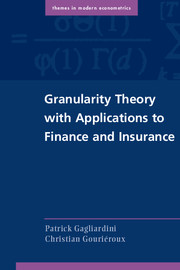
    The recent financial crisis has heightened the need for appropriate methodologies for managing and monitoring complex risks in financial markets. The measurement, management, and regulation of risks in portfolios composed of credits, credit derivatives, or life insurance contracts is difficult because of the nonlinearities of risk models, dependencies between individual risks, and the several thousands of contracts in large portfolios. The granularity principle was introduced in the Basel regulations for credit risk to solve these difficulties in computing capital reserves. In this book, authors Patrick Gagliardini and Christian Gouriéroux provide the first comprehensive overview of the granularity theory and illustrate its usefulness for a variety of problems related to risk analysis, statistical estimation, and derivative pricing in finance and insurance. They show how the granularity principle leads to analytical formulas for risk analysis that are simple to implement and accurate even when the portfolio size is large.

    Reviews

    'Credible portfolio risk assessment requires financial-econometric methods that respect the limitations of finite samples (finite numbers of assets) in real portfolios. Gagliardini and Gouriéroux propose and explore asymptotic expansions (granularity adjustments) that do just that. As expected, their book displays a wonderful clarity of thought and will be highly valued in academic, policy and practitioner circles.'

    Francis X. Diebold - Paul F. and Warren S. Miller Professor of Economics, University of Pennsylvania

    'The global financial crisis provided a stunning revelation of the complex interdependencies of risks in the banking sector and far beyond. This book provides a much-needed comprehensive study of the granularity principle designed to tackle the analysis of highly nonlinear risks imbedded in portfolios of credits or life insurance contracts. It is a timely and extremely important contribution.'

    Eric Ghysels - Edward Bernstein Professor of Economics and Professor of Finance, University of North Carolina, Chapel Hill

    'Gagliardini and Gouriéroux consolidate and advance the past decade’s developments in analysis of portfolios of not-quite-asymptotic size. This unique monograph offers a variety of risk management, econometric and derivative pricing applications in a clear and unified framework.'

    Michael Gordy

    Refine List

    Actions for selected content:

    Select all | Deselect all
    • View selected items
    • Export citations
    • Download PDF (zip)
    • Save to Kindle
    • Save to Dropbox
    • Save to Google Drive

    Save Search

    You can save your searches here and later view and run them again in "My saved searches".

    Please provide a title, maximum of 40 characters.
    ×

    Contents

    Metrics

    Full text views

    Total number of HTML views: 0
    Total number of PDF views: 0 *
    Loading metrics...

    Book summary page views

    Total views: 0 *
    Loading metrics...

    * Views captured on Cambridge Core between #date#. This data will be updated every 24 hours.

    Usage data cannot currently be displayed.

    Accessibility standard: Unknown

    Why this information is here

    This section outlines the accessibility features of this content - including support for screen readers, full keyboard navigation and high-contrast display options. This may not be relevant for you.

    Accessibility Information

    Accessibility compliance for the PDF of this book is currently unknown and may be updated in the future.
