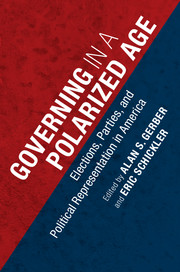

Many political observers have expressed doubts as to whether America's leaders are up to the task of addressing major policy challenges. Yet much of the critical commentary lacks grounding in the systematic analysis of the core institutions of the American political system including elections, representation, and the law-making process. Governing in a Polarized Age brings together more than a dozen leading scholars to provide an in-depth examination of representation and legislative performance. Drawing upon the seminal work of David Mayhew as a point of departure, these essays explore the dynamics of incumbency advantage in today's polarized Congress, asking whether the focus on individual re-election that was the hallmark of Mayhew's ground-breaking book, Congress: The Electoral Connection, remains useful for understanding today's Congress. The essays link the study of elections with close analysis of changes in party organization and with a series of systematic assessments of the quality of legislative performance.
'Overall, Governing in a Polarized Age is focused on representation and the impact of a member’s credit claiming, advertising, and position taking on Congress (specifically) and the executive branch (generally).'
Jacob R. Straus Source: Congress and the Presidency
Loading metrics...
* Views captured on Cambridge Core between #date#. This data will be updated every 24 hours.
Usage data cannot currently be displayed.
This section outlines the accessibility features of this content - including support for screen readers, full keyboard navigation and high-contrast display options. This may not be relevant for you.
Accessibility compliance for the PDF of this book is currently unknown and may be updated in the future.
