
Skip to main content Accessibility help
×
  • Cited by 58
    • Show more authors
    • You may already have access via personal or institutional login
    • Select format
    • Publisher:
      Cambridge University Press
      Publication date:
      10 September 2021
      15 July 2021
      ISBN:
      9781316856369
      9781107182318
      9781316632048
      Dimensions:
      (228 x 152 mm)
      Weight & Pages:
      0.72kg, 412 Pages
      Dimensions:
      (228 x 152 mm)
      Weight & Pages:
      0.58kg, 412 Pages
    You may already have access via personal or institutional login
  • Selected: Digital
    Add to cart View cart Buy from Cambridge.org

    Book description

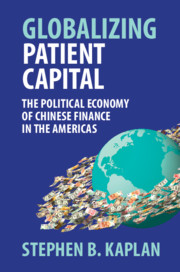
    China's overseas financing is a distinct form of patient capital that marshals the country's vast domestic resources to create commercial opportunities internationally. Its long-term risk tolerance and lack of policy conditionality has allowed developing economies to sidestep the fiscal austerity tendencies of Western markets and multilaterals. Employing statistical tests and extensive field research across China and Latin America, Stephen Kaplan finds that China's patient capital endows national governments with more room to maneuver in formulating domestic policies. The author goes on to evaluate the potential costs of Chinese financing, raising the question of how Chinese lenders will react to developing nation's ongoing struggles with debt and dependency. By disaggregating the structure of international finance, Globalizing Patient Capital has significant implications for the rise of China in Latin America, offering new insights about globalization and showing the costs and benefits of state versus market approaches to development.

    Awards

    Winner, 2023 Luciano Tomassini Book Award, Latin American Studies Association

    Reviews

    ‘The best treatment of the political economy of China-Latin America finance to date. Kaplan shows how China’s ‘patient’ capital in Latin America may have the potential to support the region’s long-term development goals - in contrast with the volatile and conditional finance from the West. Kaplan shows that Latin American countries and China alike are climbing a learning curve to maximize the benefits and minimize the risks associated with their burgeoning economic relationship, while the United States sits puzzled and increasingly alarmed.’

    Kevin Gallagher - Boston University

    ‘A valuable contribution to the burgeoning literature on China and Latin America. Kaplan argues that Chinese finance has a long-term approach and greater risk tolerance than Western capital. This enables Latin American governments to pursue their preferred development policies while avoiding the damaging cycles that have typified in the region. Both scholars and policymakers will benefit from reading the book.’

    Barbara Stallings - Brown University

    ‘A must read for understanding the shifting role of China’s international investment. Kaplan provides the most convincing and nuanced analysis for understanding the evolution of China-Latin American interconnections and their potential trajectory as part of a larger Chinese strategy of international influence. This impressive book is crucial for scholars of both Latin American politics and international political economy. It will reshape our understanding of Latin American political economy and Chinese soft international power.’

    Maria Victoria Murillo - Columbia University

    ‘Kaplan employs new loan data and hundreds of interviews to understand the costs and benefits of Chinese credit. His analysis suggests that Chinese policy banks’ longer time horizons and looser regulatory structures free borrowing governments from fiscal constraints and policy conditions. In exchange, borrowing governments offer a range of commercial concessions to their Chinese creditors, while also risking unsustainable debt burdens. This book offers important insights for anyone interested in the contemporary sovereign financing landscape.’

    Layna Mosley - Princeton University

    ‘Globalizing Patient Capital is a rich resource for scholars and policy makers who are interested in how China is reshaping the financial landscape in Latin America and the developing world in general and how Chinese loan recipients are also learning how to negotiate with China as a creditor … this book offers a deeper understanding of China’s growing financial influence in the world.’

    Victoria Chonn Ching Source: Perspectives on Politics

    '… Kaplan presents an in-depth, carefully reasoned assessment of the sudden burst in Chinese lending to Latin American governments.'

    Richard Feinberg Source: Foreign Affairs

    Refine List

    Actions for selected content:

    Select all | Deselect all
    • View selected items
    • Export citations
    • Download PDF (zip)
    • Save to Kindle
    • Save to Dropbox
    • Save to Google Drive

    Save Search

    You can save your searches here and later view and run them again in "My saved searches".

    Please provide a title, maximum of 40 characters.
    ×

    Contents

    Metrics

    Altmetric attention score

    Full text views

    Total number of HTML views: 0
    Total number of PDF views: 0 *
    Loading metrics...

    Book summary page views

    Total views: 0 *
    Loading metrics...

    * Views captured on Cambridge Core between #date#. This data will be updated every 24 hours.

    Usage data cannot currently be displayed.

    Accessibility standard: Unknown

    Why this information is here

    This section outlines the accessibility features of this content - including support for screen readers, full keyboard navigation and high-contrast display options. This may not be relevant for you.

    Accessibility Information

    Accessibility compliance for the PDF of this book is currently unknown and may be updated in the future.
