George Eliot

-
Select format
-
- Publisher:
- Cambridge University Press
- Publication date:
- March 2012
- September 2010
- ISBN:
- 9780511736339
- 9781108019613
- Dimensions:
- Weight & Pages:
- Dimensions:
- (216 x 140 mm)
- Weight & Pages:
- 0.57kg, 450 Pages
You may already have access via personal or institutional login
Show more authors 
You may already have access via personal or institutional login
Book description
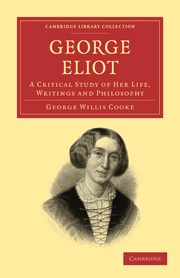
American Unitarian minister George Willis Cooke (1848–1923) worked for almost thirty years in Unitarian churches across the United States before turning full-time to scholarly pursuits in 1900. Cooke, a voracious reader who was largely self-taught, attended Meadville Theological School in Illinois but never graduated. A radical in theology and politics, he was drawn to the transcendentalist authors and in 1881 published a critical study of the works of Ralph Waldo Emerson. Cooke's George Eliot: A Critical Study of her Life, Writings and Philosophy (1883) probably emerged from those same philosophical impulses. The book was published just after Blind's biography, but Cooke asserts that with a small exception his work was complete when hers appeared; moreover, his study prioritises the act of 'interpreting and criticising [Eliot's] teachings' over the details of her life, and the book's organisation reflects this hierarchy, giving insights into the contemporary reception of George Eliot.
Contents
Contents
Metrics
Full text views
Full text views helpTotal number of HTML views: 0
Total number of PDF views: 0 *
 Loading metrics...
* Views captured on Cambridge Core between #date#. This data will be updated every 24 hours.
Usage data cannot currently be displayed.
Accessibility standard: Unknown
Why this information is here
This section outlines the accessibility features of this content - including support for screen readers, full keyboard navigation and high-contrast display options. This may not be relevant for you.
Accessibility Information
Accessibility compliance for the PDF of this book is currently unknown and may be updated in the future.