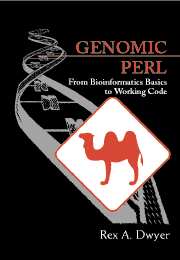

This introduction to computational molecular biology will help programmers and biologists learn the skills needed to start work in this important, expanding field. The author explains many of the basic computational problems and gives concise, working programs to solve them in the Perl programming language. With minimal prerequisites, the author explains the biological background for each problem, develops a model for the solution, then introduces the Perl concepts needed to implement the solution. The book covers pairwise and multiple sequence alignment, fast database searches for homologous sequences, protein motif identification, genome rearrangement, physical mapping, phylogeny reconstruction, satellite identification, sequence assembly, gene finding, and RNA secondary structure. The concrete examples and step-by-step approach make it easy to grasp the computational and statistical methods, including dynamic programming, branch-and-bound optimization, greedy methods, maximum likelihood methods, substitution matrices, BLAST searching, and Karlin-Altschul statistics. Perl code is provided on the accompanying CD.
‘I came away from this book not just with more knowledge about genetics and biology - indeed, siome of what I learnt has been directly applicable to some work I have - but also with an understanding of some of the complexity of the problems geneticists face. It fully satisfied its goals, expressed in the preface: teaching computer scientists the biological underpinnings of bhioinformatics … for the programmer like me, interested in what biologists do and how we can helpo them do it, it’s by far the clearest introduction available, and I would heartily recommend it.’
Simon Cozens
‘Genomic Perl gives a balanced and hands-on introduction to a set of algorithms and ideas central to the current practice of bioinformatics. its clear writing and no-frills approach to each topic should appeal to students as well as to university teachers, while providing computational biologists with a concise handbook of the ‘greatest hits’ in their field.’
Source: Naturwissenschaften
'… I found this to be an excellent book, and would not hesitate to recommend it to advanced undergraduate and postgraduate students.'
Source: Computing Reviews
'I found the descriptions and discussions to be very good, and one can easily follow along and, in fact, easily adapt the algorithms to other programming languages. this is a nice book for those who want to learn about writing programs for solving bionformatic problems, or for those teaching courses on this (or related) subjects.'
Source: Journal of the American Statistical Association
Loading metrics...
* Views captured on Cambridge Core between #date#. This data will be updated every 24 hours.
Usage data cannot currently be displayed.
This section outlines the accessibility features of this content - including support for screen readers, full keyboard navigation and high-contrast display options. This may not be relevant for you.
Accessibility compliance for the PDF of this book is currently unknown and may be updated in the future.
