Metrics
Full text views
Full text views help
Loading metrics...
* Views captured on Cambridge Core between #date#. This data will be updated every 24 hours.
Usage data cannot currently be displayed.
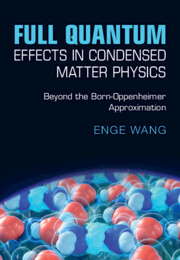
As physical science advances, theoretical simulations become increasingly reflective of realistic systems, and experimental observations become more precise and refined. Thus, going beyond the Born–Oppenheimer approximation is inevitable. This book bases its discussion of condensed matter physics on the Schrödinger equation, considering both nuclear and electronic degrees of freedom. Particular attention is given to two types of phenomena: those, such as nuclear quantum effects, for which the Born–Oppenheimer approximation, although applicable in principle, is progressively weakened in practice, and those that cannot be applied at all, such as phenomena exhibiting non-adiabatic effects. In practical systems, the full quantum nature of condensed matter, as emphasized in this book, cannot be overlooked when performing accurate simulations or measurements of material properties. This book offers state-of-the-art quantum theoretical and experimental methods, valuable for undergraduates, graduates, researchers, and industry professionals in fields such as physics, chemistry, materials science, energy, and environmental science.
‘This book fills a critical gap in condensed matter physics by addressing the inevitable shift beyond the Born–Oppenheimer approximation – a timely endeavor as simulations increasingly approach experimental and realistic precision. Grounded in the Schrödinger equation, it rigorously explores electron–nuclear coupling dynamics, focusing on overlooked phenomena: The diminished applicability of the Born–Oppenheimer approximation in nuclear quantum effects and its complete inapplicability in nonadiabatic scenarios. Integrating cutting-edge quantum theories and experimental findings, the book can serve undergraduates, graduates, researchers, and industry pros across physics, materials science, energy science, and more – guiding accurate material property studies and cross-disciplinary applications. A pivotal, far-reaching work for the field.’
Fuchun Zhang - University of Chinese Academy of Sciences
‘A concise and authoritative introduction to nuclear quantum and nonadiabatic effects in condensed matter physics, ideal for students and researchers alike. This book provides a timely and comprehensive introduction to full quantum effects in condensed matter systems, offering graduate students and researchers an invaluable resource to understand nuclear quantum and nonadiabatic effects that go beyond the Born–Oppenheimer approximation.’
Angel Rubio - Max Planck Institute for the Structure and Dynamics of Matter, and Initiative for Computational Catalysis at the Flatiron Institute
‘This book tackles the interesting and important question of quantum effects in condensed matter. It explains the underlying principles and approaches used to understand these effects. Then it brings the importance of these effects to life through numerous fascinating demonstrations of quantum effects in physics, materials, chemistry, and more. This veritable treasure trove of applications also showcases the almost symbiotic relationship there is in this field between state-of-the-arts experiment, theory, and simulation. I can see readers at various stages of advancement benefitting from this book.’
Angelos Michaelides - University of Cambridge
Loading metrics...
* Views captured on Cambridge Core between #date#. This data will be updated every 24 hours.
Usage data cannot currently be displayed.
This section outlines the accessibility features of this content - including support for screen readers, full keyboard navigation and high-contrast display options. This may not be relevant for you.
Accessibility compliance for the PDF of this book is currently unknown and may be updated in the future.
