
Skip to main content Accessibility help
×
  • Cited by 28
    • Show more authors
    • You may already have access via personal or institutional login
    • Select format
    • Publisher:
      Cambridge University Press
      Publication date:
      05 June 2012
      22 October 2009
      ISBN:
      9780511806919
      9780521846615
      9780521609104
      Dimensions:
      (198 x 129 mm)
      Weight & Pages:
      0.28kg, 160 Pages
      Dimensions:
      (198 x 129 mm)
      Weight & Pages:
      0.19kg, 160 Pages
    You may already have access via personal or institutional login
  • Selected: Digital
    Add to cart View cart Buy from Cambridge.org

    Book description

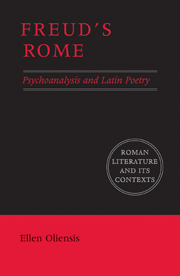
    This book is a meditation on the role of psychoanalysis within Latin literary studies. Neither a sceptic nor a true believer, Oliensis adopts a pragmatic approach to her subject, emphasizing what psychoanalytic theory has to contribute to interpretation. Drawing especially on Freud's work on dreams and slips, she spotlights textual phenomena that cannot be securely anchored in any intention or psyche but that nevertheless, or for that very reason, seem fraught with meaning; the 'textual unconscious' is her name for the indefinite place from which these phenomena erupt, or which they retroactively constitute, as a kind of 'unconsciousness-effect'. The discussion is organized around three key topics in psychoanalysis - mourning, motherhood, and the origins of sexual difference - and takes the poetry of Catullus, Virgil, and Ovid as its point of reference. A brief afterword considers Freud's own witting and unwitting engagement with the idea of Rome.

    Refine List

    Actions for selected content:

    Select all | Deselect all
    • View selected items
    • Export citations
    • Download PDF (zip)
    • Save to Kindle
    • Save to Dropbox
    • Save to Google Drive

    Save Search

    You can save your searches here and later view and run them again in "My saved searches".

    Please provide a title, maximum of 40 characters.
    ×

    Contents

    Bibliography
    Abraham, N. and Torok, M. ([1972] 1994) “Mourning or melancholia: introjection versus incorporation,” in Rand, N. T. (ed. and trans.) The Shell and the Kernel, vol. I. Chicago, 125–38
    Adams, J. N. (1982) The Latin Sexual Vocabulary. Baltimore
    Adelman, J. (1992) Suffocating Mothers: Fantasies of Maternal Origin in Shakespeare's Plays. New York
    Adelman, J.(forthcoming) “Shakespeare's Romulus and Remus: who does the wolf love?,” in del Sapio, M. (ed.) Identity, Otherness and Empire in Shakespeare's Rome. Aldershot
    Anderson, W. S. (1972) Ovid's Metamorphoses: Books 6–10. Norman
    Armstrong, R. A. (2005) A Compulsion for Antiquity: Freud and the Ancient World. Ithaca
    Anzieu, D. (1986) Freud's Self-Analysis, trans. Graham, P.. Madison
    Baker, S. (1960) “Lesbia's foot,” CP 55: 171–3
    Barchiesi, A. (2001) Speaking Volumes: Narrative and Intertext in Ovid and Other Latin Poets. London
    Barchiesi, A. (2002) “Narrative technique and narratology in the Metamorphoses,” in Hardie, P. (ed.) The Cambridge Companion to Ovid. Cambridge, 180–99
    Beard, M. (1994) “The Roman and the foreign: the cult of the ‘Great Mother’ in imperial Rome,” in Thomas, N. and Humphrey, C. (eds.) Shamanism, History, and the State. Ann Arbor, 164–90
    Bellamy, E. J. (1992) Translations of Power: Narcissism and the Unconscious in Epic History. Ithaca
    Benjamin, J. (1995) “The omnipotent mother,” in Like Subjects, Love Objects. New Haven, 81–113
    Bersani, L. (1986) The Freudian Body. New York
    Bettini, M. (1991) Anthropology and Roman Culture, trans. Sickle, J.. Baltimore
    Bettini, M. (1999) The Portrait of the Lover, trans. Gibbs, L.. Berkeley
    Bradley, K. R. (1991) Discovering the Roman Family. Oxford
    Brown, P. and Levinson, S. C. (1987) Politeness: Some Universals in Language Usage. Cambridge
    Brown, S. A. (2005) Ovid: Myth and Metamorphosis. London
    Buchan, M. (2004) “Looking to the feet: the riddles of the Scylla,” in Porter, and Buchan, (2004b), 21–49
    Burke, K. ([1939] 1973) “Freud – and the analysis of poetry,” in The Philosophy of Literary Form. Berkeley, 258–92
    Butler, J. (1993) Bodies That Matter: On the Discursive Limits of “Sex”. New York
    Butrica, J. L. (2007) “History and transmission of the text,” in Skinner, (2007b), 13–34
    Cahoon, L. (2005) “Haunted husbands: Orpheus's song (Ovid, Metamorphoses 10–11) in light of Ted Hughes's Birthday Letters,” in Batstone, W. W. and Tissol, G. (eds.) Defining Genre and Gender in Latin Literature. New York, 239–68
    Caldwell, R. S. (1989) The Origin of the Gods: A Psychoanalytic Study of Greek Theogonic Myth. New York
    Chasseguet-Smirgel, J. (1970) “Feminine guilt and the Oedipus complex,” in Chasseguet-Smirgel, J. (ed.) Female Sexuality. London, 94–134
    Clauss, J. J. (1995) “A delicate foot on the well-worn threshold: paradoxical imagery in Catullus 68b,” AJP 116: 237–53
    Coleman, R. (1977) Vergil: Eclogues. Cambridge
    Crabbe, A. (1981) “Structure and content in Ovid's Metamorphoses,” ANRW II.31.4: 2274–327
    Culler, J. (1984) “Textual self-consciousness and the literary unconscious,” Style 18: 369–76
    Currie, B. (1996) “A note on Catullus 63.5,” CQ 46: 579–81
    Damrosch, D. (1986) “The politics of ethics: Freud and Rome,” in Smith, J. H. and Kerrigan, W. (eds.) Pragmatism's Freud. Baltimore, 102–25
    Derrida, J. (1987) The Post Card, trans. Bass, A.. Chicago
    Dixon, S. (1988) The Roman Mother. Norman
    duBois, P. (1988) Sowing the Body: Psychoanalysis and Ancient Representations of Women. Chicago
    Elder, J. P. (1951) “Notes on some conscious and subconscious elements in Catullus' poetry,” HSCP 60: 101–36
    Enterline, L. (2000) The Rhetoric of the Body from Ovid to Shakespeare. Cambridge
    Farrell, J. (1999) “Aeneid 5: poetry and parenthood,” in Perkell, C. (ed.) Reading Vergil's Aeneid. Norman, 96–110
    Farrell, J. (2005) “Intention and intertext,” Phoenix 59: 98–111
    Feeney, D. C. (1992) “‘Shall I compare thee …?’ Catullus 68b and the limits of analogy,” in Woodman, T. and Powell, J. (eds.) Author and Audience in Latin Literature. Cambridge, 33–44
    Feeney, D. C. (1995) “Criticism ancient and modern,” in Innes, D., Hine, H., and Pelling, C. (eds.) Ethics and Rhetoric: Classical Essays for Donald Russell on his Seventy-Fifth Birthday. Oxford, 301–12
    Feldherr, A. (1997) “Livy's revolution: civic identity and the creation of the res publica,” in Habinek, T. and Schiesaro, A. (eds.) The Roman Cultural Revolution. Cambridge, 136–57
    Feldherr, A. (2000) “Non inter nota sepulcra: Catullus 101 and Roman funerary ritual,” CA 19: 209–31
    Feldman, A. B. (1962) “Lapsus linguae in Latin comedy,” CJ 57: 354–5
    Fitzgerald, W. (1995) Catullan Provocations. Berkeley
    Forsyth, P. Y. (1980) “Catullus 64: Dionysus reconsidered,” in Deroux, C. (ed.) Studies in Latin Literature and Roman History, vol. II. Brussels, 98–105
    Fredrick, D. (ed.) (2002) The Roman Gaze: Vision, Power, and the Body. Baltimore
    Freud, S. (1900) The Interpretation of Dreams, SE IV; V: 339–625
    Freud, S. (1901) The Psychopathology of Everyday Life, SE VI
    Freud, S. (1905) Three Essays on the Theory of Sexuality, SE VII: 130–243
    Freud, S. (1917) “Mourning and melancholia,” SE XIV: 243–58
    Freud, S. (1918) “The taboo of virginity,” SE XI: 193–208
    Freud, S. (1920) Beyond the Pleasure Principle, SE XVIII: 7–64
    Freud, S. (1922) “Medusa's head,” SE XVIII: 273–4
    Freud, S. (1923a) The Ego and the Id, SE XIX: 12–66
    Freud, S. (1923b) “A short account of psycho-analysis,” SE XIX: 191–209
    Freud, S. (1924) “The dissolution of the Oedipus complex,” SE XIX: 173–9
    Freud, S. (1925) “Some psychical consequences of the anatomical distinction between the sexes,” SE XIX: 248–58
    Freud, S. (1927) “Fetishism,” SE XXI: 152–8
    Freud, S. (1930) Civilization and its Discontents, SE XXI: 64–145
    Freud, S. ([1930] 1994) Das Unbehagen in der Kultur und andere kulturtheoretische Schriften. Frankfurt am Main
    Freud, S. (1931) “Female sexuality,” SE XXI: 225–43
    Gaisser, J. H. (1995) “Threads in the labyrinth: competing views and voices in Catullus 64,” AJP 116: 579–616
    Galvagno, R. (1995) Le sacrifice du corps: frayages du fantasme dans les Métamorphoses d'Ovide. Panormitis
    Gardner, J. F. (1998) “Sexing a Roman: imperfect men in Roman law,” in Foxhall, L. and Salmon, J. (eds.) When Men Were Men: Masculinity, Power and Identity in Classical Antiquity. London, 136–52
    Gibson, R. K. (2003) Ovid: Ars Amatoria Book 3. Cambridge
    Gilman, S. L. (1995) Freud, Race, and Gender. Princeton
    Godwin, J. (1995) Catullus: Poems 61–68. Oxford
    Gowers, E. (2002) “Blind eyes and cut throats: amnesia and silence in Horace Satires 1.7,” CP 97: 145–61
    Gowing, A. (2005) Empire and Memory: The Representation of the Roman Republic in Imperial Culture. Cambridge
    Griffith, M. (2005) “The subject of tragedy in Sophocles' Antigone,” in Pedrick, V. and Oberhelman, S. (eds.) The Soul of Tragedy: Essays on Athenian Drama. Chicago, 91–135
    Gunderson, E. (2003) Declamation, Paternity, and Roman Identity. Cambridge
    Gutzwiller, K. (1992) “Callimachus' Lock of Berenice: fantasy, romance, and propaganda,” AJP 113: 359–85
    Hallett, C. H. (2005) The Roman Nude: Heroic Portrait Statuary 200 BC–AD 300. Oxford
    Hardie, P. (1993) The Epic Successors of Virgil. Cambridge
    Hardie, P. (1994) Virgil: Aeneid Book IX. Cambridge
    Hardie, P. (2002) Ovid's Poetics of Illusion. Cambridge
    Hardie, P. (2004) “Approximative similes: incest and doubling,” Dictynna 1: 83–112
    Hardie, P. (2006) “Virgil's Ptolemaic relations,” JRS 96: 25–41
    Hershkowitz, D. (1998) The Madness of Epic: Reading Insanity from Homer to Statius. Oxford
    Heslin, P. J. (2005) The Transvestite Achilles: Gender and Genre in Statius' Achilleid. Cambridge
    Hinds, S. (1998) Allusion and Intertext. Cambridge
    Holzberg, N. (1998) “Ter quinque volumina as carmen perpetuum: the division into books in Ovid's Metamorphoses,” MD 40: 77–98
    Holzberg, N. (2002) Catull: Der Dichter und sein erotisches Werk. Munich
    Hooper, R. W. (1985) “In defense of Catullus's dirty sparrow,” G&R 32: 162–78
    Horney, K. ([1926] 1967) “The flight from womanhood,” in Kelman, H. (ed.) Feminine Psychology. New York, 54–70
    Hubbard, T. K. (1984) “Catullus 68: the text as self-demystification,” Arethusa 17: 29–49
    Hunter, R. (2006) The Shadow of Callimachus: Studies in the Reception of Hellenistic Poetry at Rome. Cambridge
    Hutchinson, G. O. (2003) “The Catullan corpus, Greek epigram, and the poetry of objects,” CQ 53: 206–21
    Irigaray, L. (1991) “The bodily encounter with the mother,” in Whitford, M. (ed.) The Irigaray Reader, trans. Macey, D.. Oxford, 34–46
    Jackson, S. (2001) “Callimachus: Coma Berenices: origins,” Mnemosyne 54: 1–9
    Jacobsen, G. A. (1984) “Apollo and Tereus: parallel motifs in Ovid's Metamorphoses,” CJ 80: 45–52
    Janan, M. (1988) “The book of good love? Design versus desire in Met. 10,” Ramus 17: 110–37
    Janan, M. (1994) “When the Lamp is Shattered”: Desire and Narrative in Catullus. Carbondale
    Janan, M. (2001) The Politics of Desire: Propertius IV. Berkeley
    Jones, E. (1927) “The early development of female sexuality,” International Journal of Psycho-Analysis 8: 459–72
    Kellum, B. (1996) “The phallus as signifier: the forum of Augustus and rituals of masculinity,” in Kampen, N. (ed.) Sexuality in Ancient Art. Cambridge, 170–83
    Kennedy, D. F. (2004), “Afterword,” in Porter and Buchan (2004b), 247–57
    Klein, M. ([1929] 1975) “Infantile anxiety-situations reflected in a work of art and in the creative impulse,” in Love, Guilt and Reparation & Other Works 1921–1945. London, 210–18
    Klein, M. ([1957] 1975) “Envy and gratitude,” in Envy and Gratitude & Other Works. London, 176–235
    Klein, M. ([1963] 1975) “Some reflections on the Oresteia,” in Envy and Gratitude & Other Works. London, 275–99
    Knox, P. E. (1990) “Scylla's nurse,” Mnemosyne 43: 158–9
    Lacan, J. ([1953] 2006) “The function and field of speech and language in psychoanalysis,” in Lacan (2006), 197–228
    Lacan, J. ([1957] 2006) “The instance of the letter in the unconscious,” in Lacan (2006), 412–41
    Lacan, J. ([1958] 2006), “The signification of the phallus,” in Lacan (2006), 575–84
    Lacan, J. ([1959] 1982) “Desire and the interpretation of desire in Hamlet,” in Felman, S. (ed.) Literature and Psychoanalysis. The Question of Reading: Otherwise. Baltimore, 11–52
    Lacan, J. ([1964] 1981) “The Freudian unconscious and ours,” in The Four Fundamental Concepts of Psycho-analysis, trans. Sheridan, A.. New York, 17–28
    Lacan, J. (2006) Écrits, trans. Fink, B.. New York
    Laird, A. (1993) “Sounding out ecphrasis: art and text in Catullus 64,” JRS 83: 18–30
    Laplanche, J. (1976) Life and Death in Psychoanalysis, trans. Mehlman, J.. Baltimore
    Leach, E. W. (1974) “Ekphrasis and the theme of artistic failure in Ovid's Metamorphoses,” Ramus 3: 102–42
    Leach, E. W. (1997) “Venus, Thetis, and the social construction of maternal behavior,” CJ 92: 347–71
    Lee, M. O. (1996) Virgil as Orpheus: A Study of the Georgics. Albany
    Liveley, G. (2003) “Tiresias/Teresa: a ‘man-made-woman’ in Ovid's Metamorphoses 3.318–38,” Helios 30: 147–62
    Loraux, N. (1998) Mothers in Mourning, trans. Pache, C.. Ithaca
    Lyne, R. O. A. M. (1987) Further Voices in Vergil's Aeneid. Oxford
    Lyne, R. O. A. M. (1989) Words and the Poet: Characteristic Techniques of Style in Vergil's Aeneid. Oxford
    Martin, C. (1992) Catullus. New Haven
    Masson, J. M. (1985) The Complete Letters of Sigmund Freud to Wilhelm Fliess, 1887–1904. Cambridge, Mass.
    Mathews, G. (2002) “Non aliena tamen: the erotics and poetics of narcissistic sadomasochism in Propertius 1.15,” Helios 29: 27–53
    Mellard, J. M. (2006) Beyond Lacan. Albany
    Miller, P. A. (2004) Subjecting Verses: Latin Love Elegy and the Emergence of the Real. Princeton
    Mitchell, J. (1982) “Introduction – I,” in Mitchell, J. and Rose, J. (eds.) Feminine Sexuality. New York, 1–26
    Mitchell-Boyask, R. N. (1996) “Sine fine: Vergil's masterplot,” AJP 117: 289–307
    Morgan, L. (1999) Patterns of Redemption in Vergil's Georgics. Cambridge
    Most, G. W. (1992) “Disiecti membra poetae: the rhetoric of dismemberment in Neronian poetry,” in Hexter, R. and Selden, D. (eds.) Innovations of Antiquity. New York, 391–419
    Newlands, C. E. (1995) Playing With Time: Ovid and the Fasti. Ithaca
    Nugent, G. (1990) “This sex which is not one: de-constructing Ovid's hermaphrodite,” differences 2: 160–85
    Nugent, G. (1992) “The voice of the women in Aeneid 5,” Arethusa 25: 255–92
    O'Gorman, E. (2004) “Cato the Elder and the destruction of Carthage,” in Porter and Buchan (2004b), 99–126
    Oliensis, E. (2001) “Freud's Aeneid,” Vergilius 47: 39–63
    Oliensis, E. (2004) “Sibylline syllables: the intratextual Aeneid,” PCPS 50: 29–45
    Oliensis, E.(2009) “Psychoanalysis: Narcissus and Amphitruo,” in Barchiesi, A. and Scheidel, W. (eds.) The Oxford Handbook of Roman Studies. Oxford
    Orlando, F. (1978) Toward a Freudian Theory of Literature, trans. Lee, C.. Baltimore
    Panoussi, V. (2003) “Ego maenas: maenadism, marriage, and the construction of female identity in Catullus 63 and 64,” Helios 30: 101–26
    Porter, J. I. (2004) “Virgil's voids,” in Porter and Buchan (2004b), 127–56
    Porter, J. I. and Buchan, M. (2004a) “Introduction,” in Porter and Buchan (2004b), 1–21
    Porter, J. I. and Buchan, M. (eds.) (2004b) Before Subjectivity? Lacan and the Classics = Helios 31.1–2
    Price, S. R. F. (1990) “The future of dreams: from Freud to Artemidorus,” in Halperin, D. M., Winkler, J. J., and Zeitlin, F. I. (eds.) Before Sexuality: The Construction of Erotic Experience in the Ancient Greek World. Princeton, 365–87
    Putnam, M. C. J. (1982) Essays on Latin Lyric, Elegy, and Epic. Princeton
    Putnam, M. C. J. (1989) “Catullus 11 and Virgil Aen. 6.786–7,” Vergilius 35: 28–30
    Putnam, M. C. J. (1993) “The languages of Horace Odes 1.24,” CJ 88: 123–35
    Putnam, M. C. J. (1995) Virgil's Aeneid: Interpretation and Influence. Chapel Hill
    Quinn, K. (1970) Catullus: The Poems. New York
    Quinn, K. (1972) Catullus: An Interpretation. London
    Quint, D. (1993) Epic and Empire. Princeton
    Ramsey, J. T. (2003) Cicero: Philippics I–II. Cambridge
    Reckford, K. (1996) “Recognizing Venus (I),” Arion 3: 1–42
    Ricciardi, A. (2003) The Ends of Mourning: Psychoanalysis, Literature, Film. Stanford
    Richlin, A. (1999) “Cicero's head,” in Porter, J. I. (ed.) Constructions of the Classical Body. Ann Arbor, 190–211
    Riffaterre, M. (1987) “The intertextual unconscious,” in Meltzer, F. (ed.) The Trial(s) of Psychoanalysis. Chicago, 211–25
    Riviere, J. ([1929] 1986) “Womanliness as a masquerade,” in Burgin, V., Donald, J., and Kaplan, C. (eds.) Formations of Fantasy. London, 35–44
    Rochette, B. (1997) “Ruma ou roma?,” Maia 49: 215–17
    Roller, L. E. (1999) In Search of God the Mother: The Cult of Anatolian Cybele. Berkeley
    Sacks, P. M. (1985) The English Elegy: Studies in the Genre from Spenser to Yeats. Baltimore
    Sandy, G. (1971) “Catullus 63 and the theme of marriage,” AJP 92: 185–95
    Sarkissian, J. (1983) Catullus 68. An Interpretation. Leiden
    Schiesaro, A. (2003) The Passions in Play: Thyestes and the Dynamics of Senecan Drama. Cambridge
    Schiesaro, A. (2005) “Under the sign of Saturn: Dido's Kulturkampf,” in Schwindt, J. P. (ed.) La représentation du temps dans la poésie augustéenne. Heidelberg, 85–110
    Schmale, M. (2004) Bilderreigen und Erzähllabyrinth: Catulls Carmen 64. Munich
    Schmitz, T. A. (2007) Modern Literary Theory and Ancient Texts: An Introduction. Malden.
    Segal, C. P. (1986) Language and Desire in Seneca's Phaedra. Princeton
    Segal, C. P. (1994a) “Sophocles' Oedipus Tyrannus: Freud, language, and the unconscious,” in Rudnytsky, P. L. and Spitz, E. H. (eds.) Freud and Forbidden Knowledge. New York, 72–95
    Segal, C. P. (1994b) “Philomela's web and the pleasures of the text,” in Jong, I. J. F. and Sullivan, J. P. (eds.) Modern Critical Theory and Classical Literature. Leiden, 257–79
    Segal, E. (1987) Roman Laughter: The Comedy of Plautus. 2nd edn. Oxford
    Shaw, B. D. (2001) “Raising and killing children: two Roman myths,” Mnemosyne 54: 31–77
    Shoptaw, J. (2000) “Lyric cryptography,” Poetics Today 21: 221–62
    Skinner, M. B. (1997) “Ego mulier: the construction of male sexuality in Catullus,” in Hallett, J. P. and Skinner, M. B. (eds.) Roman Sexualities. Princeton, 129–50
    Skinner, M. B. (2003) Catullus in Verona. Columbus
    Skinner, M. B. (2007a) “Authorial arrangement of the collection: debate past and present,” in Skinner (2007b), 35–53
    Skinner, M. B. (ed.) (2007b) A Companion to Catullus. Malden
    Slater, P. E. ([1968] 1992) The Glory of Hera: Greek Mythology and the Greek Family. Princeton
    Sprengnether, M. (1990) The Spectral Mother: Freud, Feminism, and Psychoanalysis. Ithaca
    Starobinski, J. (1987) “Acheronta movebo,” in Meltzer, F. (ed.) The Trial(s) of Psychoanalysis. Chicago, 273–86
    Suzuki, M. (1989) Metamorphoses of Helen: Authority, Difference, and the Epic. Ithaca
    Taylor, G. (2000) Castration: An Abbreviated History of Western Manhood. New York
    Thibodeau, P. (2003) “Can Vergil cry? Epicureanism in Horace Odes 1.24,” CJ 98: 243–56
    Thomas, R. F. (1988) Virgil: Georgics, vol. 2: Books III–IV. Cambridge
    Thomsen, O. (1992) Ritual and Desire: Catullus 61 and 62 and Other Ancient Documents on Wedding and Marriage. Aarhus
    Thomson, D. F. S. (1997) Catullus. Toronto
    Timpanaro, S. (1976) The Freudian Slip: Psychoanalysis and Textual Criticism, trans. Soper, K.. London
    Toohey, P. (2004) Melancholy, Love, and Time: Boundaries of the Self in Ancient Literature. Ann Arbor
    Tsitsiou-Chelidoni, C. (2003) Ovid Metamorphosen Buch VIII. Frankfurt am Main
    Vernant, J.-P. ([1967] 1988) “Oedipus without the complex,” in Tragedy and Myth in Ancient Greece, trans. Lloyd, J.. New York, 85–111
    Weber, C. (2002) “The Dionysus in Aeneas,” CP 97: 322–43
    Wheeler, S. M. (1997) “Changing names: the miracle of Iphis in Ovid Metamorphoses 9,” Phoenix 51: 190–202
    Willbern, D. (1979) “Freud and the inter-penetration of dreams,” diacritics 9: 98–110
    Wiseman, T. P. (1984) “Cybele, Virgil and Augustus,” in Woodman, T. and West, D. (eds.) Poetry and Politics in the Age of Augustus. Cambridge, 117–28
    Wiseman, T. P. (1985) Catullus and His World. Cambridge
    Wray, D. (2001) Catullus and the Poetics of Manhood. Cambridge
    Wray, D. (2003) “What poets do: Tibullus on ‘easy’ hands,” CP 98: 217–50
    Wright, E. (1998) Psychoanalytic Criticism: A Reappraisal. 2nd edn. Cambridge
    Young, E. M. (2008) “The mediated muse: Catullus and the poetics of lyric translation,” unpublished dissertation, Berkeley

    Metrics

    Altmetric attention score

    Full text views

    Total number of HTML views: 0
    Total number of PDF views: 0 *
    Loading metrics...

    Book summary page views

    Total views: 0 *
    Loading metrics...

    * Views captured on Cambridge Core between #date#. This data will be updated every 24 hours.

    Usage data cannot currently be displayed.

    Accessibility standard: Unknown

    Why this information is here

    This section outlines the accessibility features of this content - including support for screen readers, full keyboard navigation and high-contrast display options. This may not be relevant for you.

    Accessibility Information

    Accessibility compliance for the PDF of this book is currently unknown and may be updated in the future.
