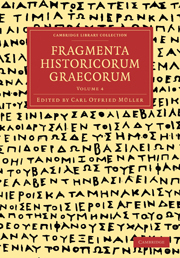

Karl Müller (1813–1894) published two standard works, Fragmenta Historicorum Graecorum and Geographi Graeci Minores, which have never been superseded, but very little is known about his life, and he is frequently confused with Carl Otfried Müller, another great German classicist of the nineteenth century. Born near Hannover, Karl and his brother and collaborator Theodor both studied at the University of Göttingen, but both left Germany in 1839, probably for political reasons. They moved to Paris, where Fragmenta was produced in partnership with the printer–publisher Ambroise Firmin-Didot. It covers histories which have been lost, but of which fragments survive in other works. Volume 4 comprises fragments from the beginning of the reign of Constantine in 306 CE, until the reign of the emperor Phocas, 602–610 CE. Published in 1851, it includes the first modern edition of the surviving works of the Byzantine historian John of Antioch.
Loading metrics...
* Views captured on Cambridge Core between #date#. This data will be updated every 24 hours.
Usage data cannot currently be displayed.
This section outlines the accessibility features of this content - including support for screen readers, full keyboard navigation and high-contrast display options. This may not be relevant for you.
Accessibility compliance for the PDF of this book is currently unknown and may be updated in the future.
