
Skip to main content Accessibility help
×
  • Cited by 9
    • Show more authors
    • You may already have access via personal or institutional login
    • Select format
    • Publisher:
      Cambridge University Press
      Publication date:
      06 October 2017
      01 September 2017
      ISBN:
      9781316493281
      9781107141094
      9781316506264
      Dimensions:
      (228 x 152 mm)
      Weight & Pages:
      0.57kg, 308 Pages
      Dimensions:
      (229 x 152 mm)
      Weight & Pages:
      0.53kg, 310 Pages
    You may already have access via personal or institutional login
  • Selected: Digital
    Add to cart View cart Buy from Cambridge.org

    Book description

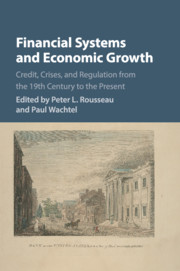
    Throughout much of the twentieth century, economists paid little heed to the role of financial intermediaries in procuring a beneficial allocation of capital. By the end of the century, however, some financial historians had begun to turn the tide, and the phrase 'finance-growth nexus' became part of the lexicon of modern economics. Recent experience has added another dimension in that countries with broader, deeper and more active financial systems might be prone to financial crises, particularly if regulatory structures are inadequate. In this book, Peter L. Rousseau and Paul Wachtel have gathered together some of today's most distinguished financial historians to examine this finance-growth nexus from both historical and modern perspectives. Some essays examine the nexus in a particular historical or cross-country context. Others, in the light of recent experience, explore the expanded nexus of finance, growth, crises, and regulation.

    Reviews

    ‘What kind of financial system meets the needs the needs of the economy and how best to avoid excessive financialization and instability are pressing policy issues in the wake of the Great Recession and Global Financial Crisis. These are also issues on which historical evidence sheds valuable light, as the contributors to this fine volume make demonstrably clear. Not only scholars, but also policy makers and regulators, should pay heed to this book.'

    Barry Eichengreen - University of California, Berkley

    'This is an important collection of new essays by leading economic and financial historians and economists. Covering a broad range of countries and time periods, they make an excellent and compelling case for the at times overlooked contribution of different types of financial developments to economic growth and change.'

    Stanley L. Engerman - University of Rochester

    'In this book, some of the top financial historians in the world explain how the various parts of the complex American financial system evolved through past crises. In the process, eventually the financial system learned how to sustain economic growth. This time will not be different if their lessons from history are learned.'

    Larry D. Neal - University of Illinois, Urbana-Champaign

    Refine List

    Actions for selected content:

    Select all | Deselect all
    • View selected items
    • Export citations
    • Download PDF (zip)
    • Save to Kindle
    • Save to Dropbox
    • Save to Google Drive

    Save Search

    You can save your searches here and later view and run them again in "My saved searches".

    Please provide a title, maximum of 40 characters.
    ×

    Contents

    Metrics

    Full text views

    Total number of HTML views: 0
    Total number of PDF views: 0 *
    Loading metrics...

    Book summary page views

    Total views: 0 *
    Loading metrics...

    * Views captured on Cambridge Core between #date#. This data will be updated every 24 hours.

    Usage data cannot currently be displayed.

    Accessibility standard: Unknown

    Why this information is here

    This section outlines the accessibility features of this content - including support for screen readers, full keyboard navigation and high-contrast display options. This may not be relevant for you.

    Accessibility Information

    Accessibility compliance for the PDF of this book is currently unknown and may be updated in the future.
