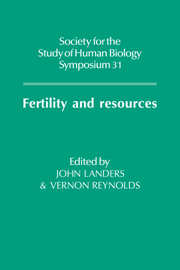

Fertility in animals reflects access to scarce resources, such as food and territory. In humans the situation is more complex. Patterns of breast feeding, contraception and ideas about age at marriage and desired family size all affect fertility. The relation between these and access to scarce resources such as housing and employment, via income, education and other factors that affect status, is explored. In this book, the gap between socio-ecology and population demography is bridged, by showing how animals and humans adjust their fertility to environmental conditions.
"...should be read by researchers who are interested in both historical and contemporary fertility trends." American Journal of Physical Anthropology
"...will appeal to reproductive ecologists, demographic anthropologists, and particularly to demographers." Gillian R. Bentley, American Anthropologist
Loading metrics...
* Views captured on Cambridge Core between #date#. This data will be updated every 24 hours.
Usage data cannot currently be displayed.
This section outlines the accessibility features of this content - including support for screen readers, full keyboard navigation and high-contrast display options. This may not be relevant for you.
Accessibility compliance for the PDF of this book is currently unknown and may be updated in the future.
