
Skip to main content Accessibility help
×
  • Cited by 4
    • Show more authors
    • You may already have access via personal or institutional login
    • Select format
    • Publisher:
      Cambridge University Press
      Publication date:
      07 October 2023
      05 October 2023
      ISBN:
      9781009128476
      9781009123228
      9781009124447
      Dimensions:
      (229 x 152 mm)
      Weight & Pages:
      0.57kg, 300 Pages
      Dimensions:
      (229 x 152 mm)
      Weight & Pages:
      0.437kg, 300 Pages
    You may already have access via personal or institutional login
  • Selected: Digital
    Add to cart View cart Buy from Cambridge.org

    Book description

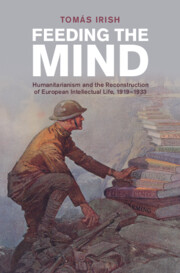
    Feeding the Mind explores how European intellectual life was rebuilt after the cataclysm of the First World War. Learned communities were left in ruins by the conflict and its consequences; cultural and educational sites were destroyed, writers and artists were killed in battle, and tens of thousands of others were displaced. Against the backdrop of an unprecedented post-war humanitarian crisis which threatened millions with starvation and disease, many organisations chose to focus on assisting intellectuals and their institutions, giving them food, medicine and books in order to stabilise European democracies and build a peaceful international order. Drawing on examples from Austria to Russia and Belgium to Serbia, Feeding the Mind analyses the role of humanitarianism in post-conflict reconstruction and explores why ideas and intellectuals were deemed to be worth protecting at a time of widespread crisis. This issue was pertinent in the century that followed and remains so today.

    Reviews

    ‘In the tumultuous aftermath of the Great War, governments, humanitarian organizations, and philanthropists, driven by their preoccupation with civilizational decline, mobilized both to save intellectuals - identified as a category especially deserving of assistance - and to rebuild institutions of knowledge. This neglected history of ‘intellectual relief’ is the great topic of Tomás Irish’s innovative, and powerful book. His new research should be widely read at a time when intellectual life and cultural heritage are constantly threatened by the many crises of the new millennium.’

    Bruno Cabanes - Ohio State University

    ‘This book reveals how humanitarianism after 1918 was inspired as much by the desire to feed minds as hungry bodies. Middle-class youth is at the heart of an exciting history that binds the reconstruction of Europe with the battle to revive faith in the value of learning and international exchange.’

    Patricia Clavin - University of Oxford

    ‘Touching, among other things, on aspects of institutional history, cultural history, the history of political language, the history of intellectuals, and the history of knowledge, while not shying away from the nitty-gritty details of humanitarian practices, the brick-and-mortar aspects of the reconstruction of repositories of knowledge, or the logistics involved in the physical transmission of books, Feeding the Mind treats its subject from what one might call a total-historian perspective. Based on impressive archival research, this wide-ranging approach adds immense flavour to the post-war period, from the First World War to Locarno and reveals some of the ways in which the war experience shaped the post-war world. The book, then, offers rich insights to students and scholars of the interlinked histories of war, intellectuals, and humanitarianism, as well as those grappling with the First World War’s impact on the post-war era’s societies and intellectual lives.’

    Frederik Forrai Ørskov Source: First World War Studies

    ‘… a vital contribution to readers' understanding of European culture between the world wars … Recommended.’

    R. W. Lemmons Source: CHOICE

    ‘This is a valuable account of how civilizational projects and intellectuals and knowledge production combine into a form of humanitarianism unlike most. … Irish does a masterful job of showing how the repair of intellectual life and civilization became entangled and the object of key philanthropies and relief agencies.’

    Michael Barnett Source: American Historical Review

    ‘… an impressive work of transnational history, and one that should find a welcome audience among historians of interwar Europe and intellectual history alike.’

    Daniel Gorman Source: The Journal of Modern History

    Refine List

    Actions for selected content:

    Select all | Deselect all
    • View selected items
    • Export citations
    • Download PDF (zip)
    • Save to Kindle
    • Save to Dropbox
    • Save to Google Drive

    Save Search

    You can save your searches here and later view and run them again in "My saved searches".

    Please provide a title, maximum of 40 characters.
    ×

    Contents

    Metrics

    Altmetric attention score

    Full text views

    Total number of HTML views: 0
    Total number of PDF views: 0 *
    Loading metrics...

    Book summary page views

    Total views: 0 *
    Loading metrics...

    * Views captured on Cambridge Core between #date#. This data will be updated every 24 hours.

    Usage data cannot currently be displayed.

    Accessibility standard: Unknown

    Why this information is here

    This section outlines the accessibility features of this content - including support for screen readers, full keyboard navigation and high-contrast display options. This may not be relevant for you.

    Accessibility Information

    Accessibility compliance for the PDF of this book is currently unknown and may be updated in the future.
