
Skip to main content Accessibility help
×
  • Cited by 11
    • Show more authors
    • You may already have access via personal or institutional login
    • Select format
    • Publisher:
      Cambridge University Press
      Publication date:
      09 March 2020
      19 March 2020
      ISBN:
      9781108863612
      9781108495929
      Dimensions:
      (228 x 152 mm)
      Weight & Pages:
      0.68kg, 386 Pages
      Dimensions:
      Weight & Pages:
    You may already have access via personal or institutional login
  • Selected: Digital
    Add to cart View cart Buy from Cambridge.org

    Book description

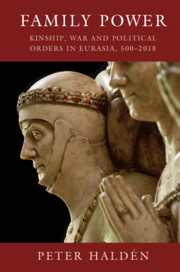
    Since the seventeenth century, scholars have argued that kinship as an organizing principle and political order are antithetical. This book shows that this was simply not the case. Kinship, as a principle of legitimacy and in the shape of dynasties, was fundamental to political order. Throughout the last one and a half millennia of European and Middle Eastern history, elite families and polities evolved in symbiosis. By demonstrating this symbiosis as a basis for successful polities, Peter Haldén unravels long-standing theories of the state and of modernity. Most social scientists focus on coercion as a central facet of the state and indeed of power. Instead, Halden argues that much more attention must be given to collaboration, consent and common identity and institutions as elements of political order. He also demonstrates that democracy and individualism are not necessary features of modernity.

    Reviews

    In a time where Charles Tilly's bellicist explanation of state formation processes seems to dominate, Peter Haldén has made an important and outstanding contribution to the literature which partly argues that kinship was of major importance to the political order emerging in Europe and the Middle East and partly proves that not only coercion but also collaboration, negotiations and consent were essential aspects of the political orders. There is no doubt that this will become a seminal text in reintroducing the kinship as a key concept to understand the development of political orders and political institutions. It is really a work of clarity and depth which ought to set the agenda for the debates about European state formation processes.

    Lars Bo Kaspersen - Copenhagen Business School

    In a pathbreaking study of extraordinary historical and comparative scope, Halden brings the family back into politics from the shadow world to which it has been relegated by modern social science. He shows just how central kinship groups are to the creation and success of political orders and develops a richer understanding of the state that decenter's Weber's emphasis on violence and bureaucracy.

    Richard Ned Lebow - King's College London

    Refine List

    Actions for selected content:

    Select all | Deselect all
    • View selected items
    • Export citations
    • Download PDF (zip)
    • Save to Kindle
    • Save to Dropbox
    • Save to Google Drive

    Save Search

    You can save your searches here and later view and run them again in "My saved searches".

    Please provide a title, maximum of 40 characters.
    ×

    Contents

    Metrics

    Altmetric attention score

    Full text views

    Total number of HTML views: 0
    Total number of PDF views: 0 *
    Loading metrics...

    Book summary page views

    Total views: 0 *
    Loading metrics...

    * Views captured on Cambridge Core between #date#. This data will be updated every 24 hours.

    Usage data cannot currently be displayed.

    Accessibility standard: Unknown

    Why this information is here

    This section outlines the accessibility features of this content - including support for screen readers, full keyboard navigation and high-contrast display options. This may not be relevant for you.

    Accessibility Information

    Accessibility compliance for the PDF of this book is currently unknown and may be updated in the future.
