Fabricating Authenticity in Soviet Hungary

-
Select format
-
- Publisher:
- Anthem Press
- Publication date:
- April 2014
- March 2014
- ISBN:
- 9780857281142
- 9780857281104
- Dimensions:
- Weight & Pages:
- 00kg,
- Dimensions:
- Weight & Pages:
You may already have access via personal or institutional login
Show more authors 
You may already have access via personal or institutional login
Book description
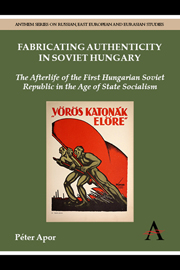
This book explores the memory of the First Hungarian Soviet Republic of 1919, which proved crucial for communist Hungarian political culture in the twentieth century. Apor approaches the topic in an innovative way, focusing on the understudied aspects of European memory cultures. Offering great insights on how a dictatorship remembers and the concept of authenticity, Apor's study integrates the broad range of processes through which history is sought to be rendered authentic. The volume successfully reveals the crooked history of the retrospective revisions of the iconic First Republic between the years of its 30th and 40th anniversary, 1949 and 1959.
Contents
Contents
Metrics
Full text views
Full text views helpTotal number of HTML views: 0
Total number of PDF views: 0 *
 Loading metrics...
* Views captured on Cambridge Core between #date#. This data will be updated every 24 hours.
Usage data cannot currently be displayed.
Accessibility standard: Unknown
Why this information is here
This section outlines the accessibility features of this content - including support for screen readers, full keyboard navigation and high-contrast display options. This may not be relevant for you.
Accessibility Information
Accessibility compliance for the PDF of this book is currently unknown and may be updated in the future.