
Skip to main content Accessibility help
×
  • Cited by 3
    • You may already have access via personal or institutional login
    • Select format
    • Publisher:
      Cambridge University Press
      Publication date:
      June 2014
      March 2014
      ISBN:
      9781107590274
      9781107067493
      9781107696211
      Dimensions:
      (247 x 174 mm)
      Weight & Pages:
      1kg, 377 Pages
      Dimensions:
      (247 x 174 mm)
      Weight & Pages:
      0.84kg, 377 Pages
    You may already have access via personal or institutional login
  • Selected: Digital
    Add to cart View cart Buy from Cambridge.org

    Book description

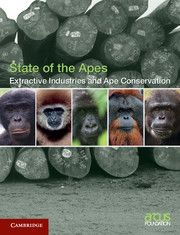
    Current dominant thinking and practice in the private and public sectors asserts that peoples' development needs are in conflict with, or mutually exclusive to, the need to conserve the biosphere on which we depend. Consequently, we are asked to either diminish development in the name of conservation or diminish conservation in the name of development. Efforts to identify complementary objectives, or mutually acceptable trade-offs and compromises indicate, however, that this does not always have to be the case. This first volume in the State of the Apes series draws attention to the evolving context within which great ape and gibbon habitats are increasingly interfacing with extractive industries. Intended for a broad range of policy makers, industry experts, decision makers, academics, researchers and NGOs, these publications aim to influence debate, practice and policy, seeking to reconcile ape conservation and welfare, and economic and social development, through objective and rigorous analysis.

    Reviews

    '… a very good overview … The authors are experts and the explanations and examples are up-to-date.'

    Source: Gorilla Journal

    'This book is about the consequences that extractive industry is having on the tropical forests of Africa and Asia and the remaining apes that live within them. It is about the local, regional, and national policies that govern the extractive industry and the steps towards mitigation that stakeholders can consider. It has no fairy tale ending; it proposes no silver bullet. Rather, it is an attempt to lay out the consequences of today’s resource extraction practices on ape communities and more importantly, encourage a shift towards acceptance that this industry and the environment are inexplicably connected … an important contribution towards identifying both the challenges and potential solutions involved in ape habitat conservation, written by a foundation that is a world leader in safeguarding wild and captive apes … Anyone interested in being familiar with how best to resolve this broader, widespread conflict must read this book.'

    Alex K. Piel Source: Primate Eye

    Refine List

    Actions for selected content:

    Select all | Deselect all
    • View selected items
    • Export citations
    • Download PDF (zip)
    • Save to Kindle
    • Save to Dropbox
    • Save to Google Drive

    Save Search

    You can save your searches here and later view and run them again in "My saved searches".

    Please provide a title, maximum of 40 characters.
    ×

    Contents

    Metrics

    Altmetric attention score

    Full text views

    Total number of HTML views: 0
    Total number of PDF views: 0 *
    Loading metrics...

    Book summary page views

    Total views: 0 *
    Loading metrics...

    * Views captured on Cambridge Core between #date#. This data will be updated every 24 hours.

    Usage data cannot currently be displayed.

    Accessibility standard: Unknown

    Why this information is here

    This section outlines the accessibility features of this content - including support for screen readers, full keyboard navigation and high-contrast display options. This may not be relevant for you.

    Accessibility Information

    Accessibility compliance for the PDF of this book is currently unknown and may be updated in the future.
