
Skip to main content Accessibility help
×
  • Cited by 4
    • Show more authors
    • Open Access
      You have digital access to this book
    • Select format
    • Publisher:
      Cambridge University Press
      Publication date:
      June 2023
      June 2023
      ISBN:
      9781009284776
      9781009284721
      Creative Commons:
      Creative Common License - CC Creative Common License - BY Creative Common License - NC
      This content is Open Access and distributed under the terms of the Creative Commons Attribution licence CC-BY-NC 4.0.
      https://creativecommons.org/creativelicenses
      Dimensions:
      (229 x 152 mm)
      Weight & Pages:
      0.56kg, 288 Pages
      Dimensions:
      Weight & Pages:
    Open Access
    You have digital access to this book
    Selected: Digital
    View content
    Add to cart View cart Buy from Cambridge.org

    Book description

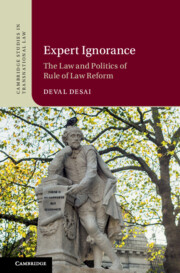
    Today, a transnational constellation of 'rule of law' experts advise on 'good' legal systems to countries in the Global South. Yet these experts often claim that the 'rule of law' is nearly impossible to define, and they frequently point to the limits of their own expertise. In this innovative book, Deval Desai identifies this form of expertise as 'expert ignorance'. Adopting an interdisciplinary approach, Desai draws on insights from legal theory, sociology, development studies, and performance studies to explore how this paradoxical form of expertise works in practice. With a range of illustrative cases that span both global and local perspectives, this book considers the impact of expert ignorance on the rule of law and on expert governance more broadly. Contributing to the study of transnational law, governance, and expertise, Desai demonstrates the enduring power of proclaiming what one does not know. This title is available as Open Access on Cambridge Core.

    Awards

    Runner-up, 2024 Peter Birks Prize, The Society of Legal Scholars

    Reviews

    ‘‘Disenchanted’ expertise that becomes ‘self-denying’ rests on and professes ignorance. In this provocative, innovative, and elegant book, Desai explores ‘expert ignorance’ in rule of law reform performances. He argues that expert ignorance moves the rule of law in the direction of ‘Governance’. Critical and political, the argument deserves engagement.’

    Anna Leander - Professor of International Relations and Political Science, Geneva Graduate Institute

    ‘In this pathbreaking study of the field of rule of law reform, Desai explores the productive power of ‘ignorance work’ as a form of expert practice, examining the ways in which it helps to produce ‘provisional, fluid, and reconfigurable’ forms of the rule of law. With this innovative argument, which draws on his own years of experience as a practitioner in the field, Desai firmly establishes himself as one of the most insightful analysts of reflexive expertise, not only in the field of development but also beyond. This book is at the cutting edge of new thinking in critical development studies and global economic governance.’

    Andrew Lang - Chair in International Law and Global Governance, University of Edinburgh

    ‘Desai applies a sophisticated theoretical perspective to critically examine the ideas and actions of law and development scholars and practitioners. This penetrating and challenging first-hand look at expert ignorance defies categorisation and stands out in imagination and insight.’

    Brian Tamanaha - John S. Lehmann University Professor, Washington University in St Louis

    ‘In international development, ‘building the rule of law’ has the paradoxical status of being perhaps its most widely supported yet least successful policy objective. To this day, its leading practitioners openly concede that they ‘don’t know what they are doing’ - or, indeed, what the rule of law itself even is. Desai provides an insightful, compelling, and intellectually innovative explanation of this paradox: law and development is replete with expert ignorance, requiring its champions to simultaneously own and disown, deploy and withhold, assert and deny, their expertise - with all manner of vexing consequences. Forging a world in which its most marginalised citizens begin to experience the law as a legitimate, accessible, and effective part of the solution to (rather than a source and compounder of) their problems requires all of us to join Desai in diligently wrestling with this truly unique challenge, in an ongoing quest for the correspondingly unique responses it necessarily requires.’

    Michael Woolcock - World Bank and Harvard University

    ‘This erudite, engaging, and elegantly crafted book trespasses disciplinary boundaries to offer rich and unexpected insights for legal and social theorists, scholars of development and international relations, and practitioners of all stripes. It demands reading by those with a critical orientation towards projects of legal change - and re-reading for Desai's eye for vivid social, political, and lived detail.’

    Shalini Randeria - President and Rector, Central European University

    ‘Desai’s own creativity as a storyteller makes the book well worth reading.’

    Tommaso Soave Source: International Affairs

    Refine List

    Actions for selected content:

    Select all | Deselect all
    • View selected items
    • Export citations
    • Download PDF (zip)
    • Save to Kindle
    • Save to Dropbox
    • Save to Google Drive

    Save Search

    You can save your searches here and later view and run them again in "My saved searches".

    Please provide a title, maximum of 40 characters.
    ×

    Contents

    Full book PDF
    • Expert Ignorance
      pp i-i
    • Cambridge Studies in Transnational Law - Series page
      pp ii-ii
    • Expert Ignorance - Title page
      pp iii-iii
    • The Law and Politics of Rule of Law Reform
    • Copyright page
      pp iv-iv
    • Dedication
      pp v-vi
    • Contents
      pp vii-ix
    • Figures
      pp x-x
    • Tables
      pp xi-xi
    • Acknowledgements
      pp xii-xiii
    • In Lieu of an Abstract
      pp xiv-xvi
    • Executive Summary
      pp xvii-xviii
    • Table of Cases
      pp xix-xix
    • Abbreviations
      pp xx-xx
    • 1 - Introduction
      pp 1-25
    • 2 - Ignorance and the Practice of Rule of Law Reform
      pp 26-48
    • 3 - Projecting the Rule of Law
      pp 49-106
    • 4 - Performing the Rule of Law
      pp 107-153
    • 5 - Law and Politics of Rule of Law Performances
      pp 154-174
    • 6 - Historicising Rule of Law Performances
      pp 175-195
    • 7 - The Sociology of Rule of Law Performers
      pp 196-214
    • 8 - Conclusion
      pp 215-237
    • Bibliography
      pp 238-259
    • Index
      pp 260-266
    • Cambridge Studies in Transnational Law - Series page
      pp 267-267

    Metrics

    Altmetric attention score

    Full text views

    Total number of HTML views: 0
    Total number of PDF views: 0 *
    Loading metrics...

    Book summary page views

    Total views: 0 *
    Loading metrics...

    * Views captured on Cambridge Core between #date#. This data will be updated every 24 hours.

    Usage data cannot currently be displayed.

    Accessibility standard: Unknown

    Why this information is here

    This section outlines the accessibility features of this content - including support for screen readers, full keyboard navigation and high-contrast display options. This may not be relevant for you.

    Accessibility Information

    Accessibility compliance for the PDF of this book is currently unknown and may be updated in the future.
