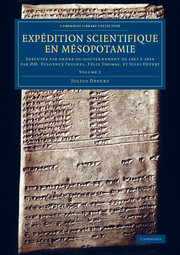
Expédition scientifique en Mésopotamie

-
Select format
-
- Publisher:
- Cambridge University Press
- Publication date:
- 05 June 2015
- 20 November 2014
- ISBN:
- 9781139979726
- 9781108078986
- Dimensions:
- Weight & Pages:
- Dimensions:
- (297 x 210 mm)
- Weight & Pages:
- 0.91kg, 380 Pages
You may already have access via personal or institutional login
Volume 2
Show more authors 
You may already have access via personal or institutional login
Book description
Born in Hamburg to Jewish parents, Julius Oppert (1825–1905) later moved to France, where he established a reputation as a remarkably gifted Assyriologist, making significant contributions to the decipherment of cuneiform Akkadian. Between 1851 and 1854, he accompanied the orientalist Fulgence Fresnel (1795–1855) on the French expedition to Mesopotamia. In recognition of his role, involving important excavations at the site of the ancient city of Babylon, Oppert was granted French citizenship. In May 1855, however, a great many of the discovered antiquities were lost when the raft transporting them sank in the Tigris under the weight of its priceless cargo. The present work appeared in two volumes between 1859 and 1863; the publication of the second volume preceded that of the first, as Oppert prioritised the analysis of the cuneiform inscriptions. Volume 2 (1859) is devoted to these inscriptions and the painstaking work of deciphering them.
Contents
Contents
Metrics
Full text views
Full text views helpTotal number of HTML views: 0
Total number of PDF views: 0 *
 Loading metrics...
* Views captured on Cambridge Core between #date#. This data will be updated every 24 hours.
Usage data cannot currently be displayed.
Accessibility standard: Unknown
Why this information is here
This section outlines the accessibility features of this content - including support for screen readers, full keyboard navigation and high-contrast display options. This may not be relevant for you.
Accessibility Information
Accessibility compliance for the PDF of this book is currently unknown and may be updated in the future.