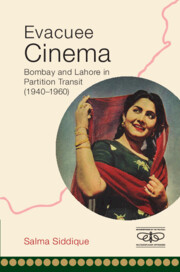

This new history of partition and South Asian cinema is narrated through the careers of émigré film personnel, as well as through the distinctive genres and ancillary ventures that accompanied the aftershocks of partition. Moving beyond arguments about social contingency and political intent, the book suggests that the creative energies, production and subsequent circulation of popular cinema can offer fresh insights into partition. Pointing to regional connections across national boundaries, this book asserts that the cinemas of India and Pakistan must be explored in tandem to uncover the legacy of partition for the culture industries of the region, one that is not hewn out of national erasures. The leitmotifs of émigré personnel, gossip and satire in film print culture, the partisan repertoire of a theatre company, the film genres of the Muslim social, romantic comedies and charba (remakes), and the unruly film archives of postcolonial nation–states, when accessed through the lens of a divisive decolonization, reveal the parallaxes and confabulations of the 'national' on both sides.
‘A brilliantly original study of the links between India’s and Pakistan’s film industries that puts into question the role of partition, war and nationalism in the cultural history of South Asia.’
Faisal Devji - University of Oxford
‘Unearthing stories of the displaced persons who transformed Bombay and Lahore into national film hubs, Salma Siddique brilliantly refutes the notion that amnesia and silence characterised their film industries’ response to partition. Delving into popular, archival and private records, Evacuee Cinema offers breathtaking insight into the frenetic world of film stars, crews, companies and theatres altering their creative trajectories to adapt to cataclysmic times. We owe a large debt of gratitude to Siddique for this riveting and immersive account of émigré film personnel whose paths crossed and recrossed the increasing political distance and hostilities between India and Pakistan during the long partition. An indispensable book that reminds us, powerfully, how two vibrant centres of film production were born from the work, life, privation and imagination of migrants and evacuees.’
Priya Jaikumar - Author of Where Histories Reside: India as Filmed Space (2019)
‘This is a pioneering study of the entangled histories of Indian and Pakistani cinema. Analysing the film industries in Bombay and Lahore in the run-up to the partition of colonial India and in the years after, Salma Siddique has done groundbreaking work. The book showcases innovative research on key genres such as the Muslim social film and the adaptation of Hollywood genres such as ‘screwball’, draws attention to the remarkable charba films that remade Bombay films through a Pakistani lens, and casts light on the ambiguities of Prithviraj Kapoor’s progressive theatre practices. Evacuee Cinema is based on careful research in a range of archives. It is a compelling, indeed indispensable work that suspends national historical approaches to capture the complex interweaving and separating out of cultural forms and practices.’
Ravi Vasudevan - Centre for the Study of Developing Societies
Loading metrics...
* Views captured on Cambridge Core between #date#. This data will be updated every 24 hours.
Usage data cannot currently be displayed.
This section outlines the accessibility features of this content - including support for screen readers, full keyboard navigation and high-contrast display options. This may not be relevant for you.
Accessibility compliance for the PDF of this book is currently unknown and may be updated in the future.
