
Skip to main content Accessibility help
×
  • Cited by 6
    • Show more authors
    • You may already have access via personal or institutional login
    • Select format
    • Publisher:
      Cambridge University Press
      Publication date:
      May 2023
      May 2023
      ISBN:
      9781009336772
      9781009336789
      9781009336796
      Dimensions:
      (229 x 152 mm)
      Weight & Pages:
      0.47kg, 228 Pages
      Dimensions:
      (229 x 152 mm)
      Weight & Pages:
      0.336kg, 228 Pages
    • Subjects:
      Ethics, Philosophy
    You may already have access via personal or institutional login
  • Selected: Digital
    Add to cart View cart Buy from Cambridge.org
    Subjects:
    Ethics, Philosophy

    Book description

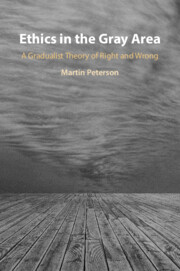
    What should morally conscientious agents do if they must choose among options that are somewhat right and somewhat wrong? Should one select an option that is right to the highest degree, or would it perhaps be more rational to choose randomly among all somewhat right options? And how should lawmakers and courts address behaviour that is neither entirely right nor entirely wrong? In this first book-length discussion of the 'gray area' in ethics, Martin Peterson challenges the assumption that rightness and wrongness are binary properties and explores acts which are neither entirely right nor entirely wrong, but rather a bit of both. Including discussions of white lies and the permissibility of abortion, Peterson's book presents a gradualist theory of right and wrong designed to answer these and other practical questions about the gray area in ethics.

    Reviews

    ‘Peterson provides a much needed clarification of what gradualism is, and makes a powerful case both that it is a decisive advance over alternatives, and that ethicists working within a broadly consequentialist framework are driven to it. He makes the case, moreover, that the ability of consequentialist theories – in particular his preferred version – to accommodate gradualism amounts to a real advantage of such theories over alternatives that eschew it. An important contribution to core debates in normative ethics and beyond.

    Paul Hurley - Claremont McKenna College

    Refine List

    Actions for selected content:

    Select all | Deselect all
    • View selected items
    • Export citations
    • Download PDF (zip)
    • Save to Kindle
    • Save to Dropbox
    • Save to Google Drive

    Save Search

    You can save your searches here and later view and run them again in "My saved searches".

    Please provide a title, maximum of 40 characters.
    ×

    Contents

    Metrics

    Altmetric attention score

    Full text views

    Total number of HTML views: 0
    Total number of PDF views: 0 *
    Loading metrics...

    Book summary page views

    Total views: 0 *
    Loading metrics...

    * Views captured on Cambridge Core between #date#. This data will be updated every 24 hours.

    Usage data cannot currently be displayed.

    Accessibility standard: Unknown

    Why this information is here

    This section outlines the accessibility features of this content - including support for screen readers, full keyboard navigation and high-contrast display options. This may not be relevant for you.

    Accessibility Information

    Accessibility compliance for the PDF of this book is currently unknown and may be updated in the future.
