
Skip to main content Accessibility help
×
  • Cited by 17
      • Rabiat Akande, Osgoode Hall Law School, York University, Toronto
      Show more authors
    • You may already have access via personal or institutional login
    • Select format
    • Publisher:
      Cambridge University Press
      Publication date:
      May 2023
      June 2023
      ISBN:
      9781009052108
      9781316511558
      9781009055048
      Dimensions:
      (229 x 152 mm)
      Weight & Pages:
      0.63kg, 338 Pages
      Dimensions:
      (229 x 152 mm)
      Weight & Pages:
      0.5kg, 338 Pages
    You may already have access via personal or institutional login
  • Selected: Digital
    Add to cart View cart Buy from Cambridge.org

    Book description

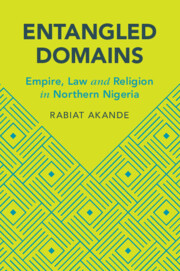
    Set in Colonial Northern Nigeria, this book confronts a paradox: the state insisted on its separation from religion even as it governed its multireligious population through what remained of the precolonial caliphate. Entangled Domains grapple with this history to offer a provocative account of secularism as a contested yet contingent mode of governing religion and religious difference. Drawing on detailed archival research, Rabiat Akande vividly illustrates constitutional struggles triggered by the colonial state's governance of religion and interrogates the legacy of that governance agenda in the postcolonial state. This book is a novel commentary on the dynamic interplay between law, faith, identity, and power in the context of the modern state's emergence from colonial processes.

    Awards

    Honorable Mention, 2023 W. Wesley Pue Book Prize, Canadian Law and Society Association

    Honorable Mention, 2024 Book Prize, International Society of Public Law

    Honorable Mention, 2024 ICONS Annual Book Prize, International Society for Public Law

    Finalist, 2024 Best Book Prize, African Studies Association

    Reviews

    ‘With the shift away from sponsoring Christian missionary projects, the British empire turned to indirect rule with secularist features. In this enterprising history of law and politics in northern Nigeria between past and present, Rabiat Akande illuminates how such secularism intruded on religious and social identity and reshaped it, with profound legacies for the constitutionalism that followed in the postcolony. This is an extremely impressive achievement.’

    Samuel Moyn - Yale Law School

    ‘Discussions of secularism often descend into arguments ‘for’ or ‘against’ secularism. Not so for Rabiat Akande’s study of the entanglements of law, religion, and empire in colonial Northern Nigeria and its postcolonial epilogue. Emphasizing the ambivalences of secular governance, Akande explores the unexpected expressions of the state’s colonial and postcolonial claims to secularity. An important contribution to the globalization of critical secularism studies.’

    Elizabeth Shakman Hurd - Northwestern University

    ‘Set in Colonial Northern Nigeria, Akande confronts a paradox: the state insisted on its separation from religion even as it governed its multi-religious population through what remained of the pre-colonial caliphate. Secularism emerges as a contested yet contingent mode of governing religion and religious difference.’

    Howard S. Erlanger Source: Law & Social Inquiry

    Refine List

    Actions for selected content:

    Select all | Deselect all
    • View selected items
    • Export citations
    • Download PDF (zip)
    • Save to Kindle
    • Save to Dropbox
    • Save to Google Drive

    Save Search

    You can save your searches here and later view and run them again in "My saved searches".

    Please provide a title, maximum of 40 characters.
    ×

    Contents

    • Introduction
      pp 1-28

    Metrics

    Altmetric attention score

    Full text views

    Total number of HTML views: 0
    Total number of PDF views: 0 *
    Loading metrics...

    Book summary page views

    Total views: 0 *
    Loading metrics...

    * Views captured on Cambridge Core between #date#. This data will be updated every 24 hours.

    Usage data cannot currently be displayed.

    Accessibility standard: Unknown

    Why this information is here

    This section outlines the accessibility features of this content - including support for screen readers, full keyboard navigation and high-contrast display options. This may not be relevant for you.

    Accessibility Information

    Accessibility compliance for the PDF of this book is currently unknown and may be updated in the future.
