English and Empire

-
Select format
-
- Publisher:
- Cambridge University Press
- Publication date:
- October 2018
- October 2018
- ISBN:
- 9781108551045
- 9781108426558
- 9781108444217
- Dimensions:
- (228 x 152 mm)
- Weight & Pages:
- 0.72kg, 368 Pages
- Dimensions:
- (229 x 152 mm)
- Weight & Pages:
- 0.55kg, 370 Pages
You may already have access via personal or institutional login
Show more authors 
You may already have access via personal or institutional login
Book description
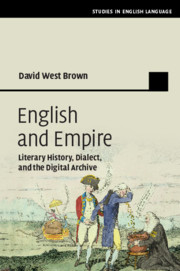
Combining statistical modelling and archival study, English and Empire investigates how African diasporic, Chinese, and Indian characters have been voiced in British fiction and drama produced between 1768 and 1929. The analysis connects patterns of linguistic representation to changes in the imperial political economy, to evolving language ideologies that circulate in the Anglophone world, and to shifts in sociocultural anxieties that crosscut race and empire. In carrying out his investigation, David West Brown makes the case for a methodological approach that links the distant (quantitative) and close (qualitative) reading of diverse digital artefacts. Taking an interdisciplinary approach, the book will appeal to a variety of scholars and students including sociolinguists interested in historical language variation, as well as literary scholars interested in postcolonial studies and the digital humanities.
Reviews
‘English and Empire is innovative in both methodology and scope. With its interdisciplinary examination of racialized literary dialect in imperial contexts, Brown's study makes crucial and needed contributions to both linguistic and literary studies.'
Taryn Hakala - University of California, Merced
‘Overall, this is an insightful study, just as much from the point of view of the methodology employed as well as with regard to the insights concerning the features used in literary texts to portray the speech patterns of colonial subjects and how these reflect attitudes and stereotypes of society at large … Linguists will benefit from the detailed descriptions and evaluations of the ‘digital toolkit’ and literary scholars will benefit from looking at corpus patterns and wider contexts of literary texts if they give it a go.’
Andrea Sand Source: Anglia
Contents
Contents
References
Metrics
Altmetric attention score
Full text views
Full text views helpTotal number of HTML views: 0
Total number of PDF views: 0 *
 Loading metrics...
* Views captured on Cambridge Core between #date#. This data will be updated every 24 hours.
Usage data cannot currently be displayed.
Accessibility standard: Unknown
Why this information is here
This section outlines the accessibility features of this content - including support for screen readers, full keyboard navigation and high-contrast display options. This may not be relevant for you.
Accessibility Information
Accessibility compliance for the PDF of this book is currently unknown and may be updated in the future.