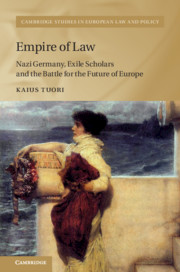

European legal integration is often justified with reference to the inherent unity of European legal traditions that extend to ancient Rome. This book explores the invention of this tradition, tracing it to a group of legal scholars divided by the onslaught of Nazi terror and totalitarianism in Europe. As exiles in Britain and the US, its formulators worked to build bridges between the Continental and the Atlantic legal traditions, incorporating ideas such as rule of law, liberty and equality to the European heritage. Others joined the Nazi revolution, which promoted its own idea of European unity. At the end of World War Two, natural law and human rights were incorporated into the European project. The resulting narrative of Europe, one that outlined human rights, rule of law and equality, became consequently a unifying factor during the Cold War as the self-definition against the challenge of communism.
'Kaius Tuori convincingly demonstrates how a narrative from Roman law to European identity was constructed in the twentieth century, and the ideological purposes the fiction was made to serve, including across the divide between National Socialist Europe and a self-styled continent of human rights. There is much to learn from Tuori’s erudition and insight.'
Samuel Moyn - Yale University
'Tuori is to be commended for producing a rich and textured work filled with important insights. This book will undoubtedly reframe the debate about the ideologies supporting the narratives of European legal history to a significant extent.'
Paul J. du Plessis - University of Edinburgh
'A deeply learned investigation of a somber history, Kaius Tuori's Empire of Law tracks the fate of the study of Roman law through the Nazi years and into the post-War effort to rebuild Europe. Indispensable reading for understanding the Roman legal tradition in Western history.'
James Whitman - Yale University
‘Tuori’s Empire of Law is a thoughtful investigation of the complex relationship between legal scholars exiled from Nazi Germany and the emergence of the idea of a European legal tradition rooted in Roman law.’
R. W. Lemmons Source: Choice
‘... Tuori’s study is a very good example of how to make use of actor-centered methods to engage with legal intellectual history and the legal history of Europe.’
Sara Weydner Source: H-Soz-Kult
Loading metrics...
* Views captured on Cambridge Core between #date#. This data will be updated every 24 hours.
Usage data cannot currently be displayed.
This section outlines the accessibility features of this content - including support for screen readers, full keyboard navigation and high-contrast display options. This may not be relevant for you.
Accessibility compliance for the PDF of this book is currently unknown and may be updated in the future.
