
Skip to main content Accessibility help
×
  • Cited by 51
    • Show more authors
    • You may already have access via personal or institutional login
    • Select format
    • Publisher:
      Cambridge University Press
      Publication date:
      12 April 2019
      02 May 2019
      ISBN:
      9781108666961
      9781108473125
      9781108461009
      Dimensions:
      (228 x 152 mm)
      Weight & Pages:
      0.62kg, 338 Pages
      Dimensions:
      (229 x 152 mm)
      Weight & Pages:
      0.518kg, 340 Pages
    You may already have access via personal or institutional login
  • Selected: Digital
    Add to cart View cart Buy from Cambridge.org

    Book description

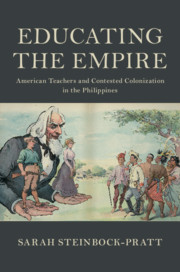
    This book examines how education contributed to the creation of US empire in the Philippines by focusing on American teachers and the Filipinos with whom they lived and worked. While education was located at the heart of the imperial project, used to justify empire, the implementation of schooling in the islands deviated from the expectations of the colonial state. American teachers at times upheld, adapted, circumvented, or entirely disregarded colonial policy. Despite the language of white masculinity that imbued imperial discourse, the appointment of white women and black men as teachers allowed them to claim roles and identities that transformed understandings of gender and race. Filipinos also used the American educational system to articulate their own understandings of empire. In this context, schools were a microcosm for the colonial state, with contestations over education often standing in for the colonial relationship itself.

    Awards

    Finalist, 2020 Mary Nickless Prize, Organization of American Historians

    Honorable Mention, 2020 Outstanding Book Award, History of Education Society

    Reviews

    'In Educating the Empire, Steinbock-Pratt carefully details the collaborations, conflicts, and dashed expectations that shaped the US colonial state's public education program in the Philippines. Rich in original research, Educating the Empire is an important contribution to histories of US colonialism in the Philippines.'

    Colleen Woods - University of Maryland

    'In this definitive and unique book, Steinbock-Pratt illuminates the experiences of the American men and women, both African-American and white, who traveled to the Philippines to educate, endure, and endorse the empire. In so doing, she tells a gripping tale about gender, race and power in the everyday institutions of imperialism; and the hopes, complexities, and limits of American empire.'

    Julian Go - Boston University

    'An impressively researched account of US teachers in the Philippines from the turn of the twentieth century to the 1930s.'

    Kristin Lee Hoganson - University of Illinois

    'Educating the Empire should be standard reading for anybody seeking to understand the cultural history of US colonialism in the Philippines.'

    Oliver Charbonneau Source: American Historical Review

    Refine List

    Actions for selected content:

    Select all | Deselect all
    • View selected items
    • Export citations
    • Download PDF (zip)
    • Save to Kindle
    • Save to Dropbox
    • Save to Google Drive

    Save Search

    You can save your searches here and later view and run them again in "My saved searches".

    Please provide a title, maximum of 40 characters.
    ×

    Contents

    Metrics

    Altmetric attention score

    Full text views

    Total number of HTML views: 0
    Total number of PDF views: 0 *
    Loading metrics...

    Book summary page views

    Total views: 0 *
    Loading metrics...

    * Views captured on Cambridge Core between #date#. This data will be updated every 24 hours.

    Usage data cannot currently be displayed.

    Accessibility standard: Unknown

    Why this information is here

    This section outlines the accessibility features of this content - including support for screen readers, full keyboard navigation and high-contrast display options. This may not be relevant for you.

    Accessibility Information

    Accessibility compliance for the PDF of this book is currently unknown and may be updated in the future.
