Economics without Preferences

-
Select format
-
- Publisher:
- Cambridge University Press
- Publication date:
- 02 January 2025
- 16 January 2025
- ISBN:
- 9781009340731
- 9781009340700
- Dimensions:
- (229 x 152 mm)
- Weight & Pages:
- 0.525kg, 258 Pages
- Dimensions:
- Weight & Pages:
You may already have access via personal or institutional login- Series:
- Studies in New Economic Thinking
Show more authors 
You may already have access via personal or institutional login
Book description
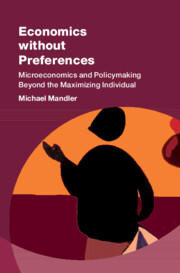
Economics without Preferences lays out a new microeconomics – a theory of choice behavior, markets, and welfare – for agents who lack the preferences and marginal judgments that economics normally relies on. Agents without preferences defy the rules of the traditional model of rational choice but they can still systematically pursue their interests. The theory that results resolves several puzzles in economics. Status quo bias and other anomalies of behavioral economics shield agents from harm; they are expressions rather than violations of rationality. Parts of economic orthodoxy go out the window. Agents will fail to make the fine-grained trade-offs ingrained in conventional economics, leading market prices to be volatile and cost-benefit analysis to break down. This book provides policy alternatives to fill this void. Governments can spur innovation, the main benefit markets can deliver, while sheltering agents from the upheavals that accompany economic change.
Reviews
‘Michael Mandler is one of the most brilliant and unorthodox minds in social science and Economics without Preferences is his masterwork. Mandler's fascinating reformulation of economic theory via the relaxation of conventional notions of rationality is pathbreaking. This book demonstrates that the empirical limitations of neoclassical theory can be constructively and compellingly addressed to produce a richer and more powerful formal framework for understanding individual and collective behavior. Every economist should study this wonderful book.’
Steven Durlauf - Director, Stone Center for Research on Wealth Inequality and Mobility, Harris School of Public Policy, University of Chicago
‘Mandler’s stimulating, thought-provoking, and enjoyable book uses the transition from good old-fashioned neoclassicism to modern economics as a springboard to his own theory of incomplete preferences. The result is an intriguing series of implications and questions for received theory. Mandler’s theoretical developments culminate in proposals to evaluate government policies by their effect on the options available to individuals rather than by classical definitions of efficiency. If that framework had been in place when steel belts became rust belts, the economic and political fallout might have taken a very different and more benign course.’
Duncan Foley - Emeritus Leo Model Professor of Economics, New School for Social Research
Contents
Contents
References
Metrics
Altmetric attention score
Full text views
Full text views helpTotal number of HTML views: 0
Total number of PDF views: 0 *
 Loading metrics...
* Views captured on Cambridge Core between #date#. This data will be updated every 24 hours.
Usage data cannot currently be displayed.
Accessibility standard: Unknown
Why this information is here
This section outlines the accessibility features of this content - including support for screen readers, full keyboard navigation and high-contrast display options. This may not be relevant for you.
Accessibility Information
Accessibility compliance for the PDF of this book is currently unknown and may be updated in the future.