Metrics
Full text views
Full text views help
Loading metrics...
* Views captured on Cambridge Core between #date#. This data will be updated every 24 hours.
Usage data cannot currently be displayed.
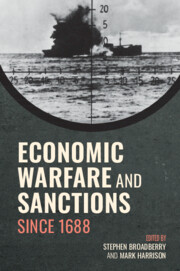
How have economic warfare and sanctions been applied in modern history, with what success and with what unintended consequences? In this book, leading economic historians provide answers through case studies ranging from the eighteenth-century rivalry of Britain and France and the American Civil War to the two world wars and the Cold War. They show how countries faced with economic measures have responded by resisting, adapting to, or seeking to pre-empt the attack so that the effects of an economic attack could be delayed or temporarily neutralised. Behind the scenes, however, economic measures shaped the course of warfare: they moulded war plans, raised the adversary's costs of mobilisation, and tipped the balance of final outcomes. This book is the first to combine the study of economic warfare and sanctions, showing the deep similarities and continuities as well as the differences, in an integrated framework.
‘In an era marked by trade wars, chip wars, and mounting economic sanctions, few books are more timely or valuable. Broadberry and Harrison’s edited volume provides indispensable, rigorously researched insights into today’s geopolitical challenges, exploring three centuries of efforts to weaponize economic relations in pursuit of political ends.’
Joseph A. Maiolo - author of Cry Havoc
‘It is hard to imagine a more topical theme, and Broadberry and Harrison are the perfect editors. Essential reading for anyone interested in globalisation, deglobalization, and the many links between trade and war.’
Kevin O’Rourke - author of Power and Plenty
‘Economic warfare has usually been regarded as a product of the twentieth-century total wars, but in this revealing and wide-ranging set of essays Harrison and Broadberry show that forms of economic warfare go back a long way and are still a twenty-first century reality. There is much here for policymakers as well as historians to reflect on.’
Richard Overy - author of Why War
‘Broadberry and Harrison have long been leading figures in understanding the economics of warfare. In this volume, they offer the definitive starting point for anyone needing to understand the central role of economic power as an instrument of coercion in security competition.’
Paul Poast - author of Wheat at War
‘This superb volume is impressive in both the breadth of its coverage and its depth. It will become required reading for anyone trying to grasp the effectiveness of economic warfare and sanctions. I only wish it did not feel so relevant to the contemporary world.’
Duncan Weldon - author of Blood and Treasure
Loading metrics...
* Views captured on Cambridge Core between #date#. This data will be updated every 24 hours.
Usage data cannot currently be displayed.
This section outlines the accessibility features of this content - including support for screen readers, full keyboard navigation and high-contrast display options. This may not be relevant for you.
The PDF of this book is known to have missing or limited accessibility features. We may be reviewing its accessibility for future improvement, but final compliance is not yet assured and may be subject to legal exceptions. If you have any questions, please contact accessibility@cambridge.org.
Allows you to navigate directly to chapters, sections, or non‐text items through a linked table of contents, reducing the need for extensive scrolling.
Provides an interactive index, letting you go straight to where a term or subject appears in the text without manual searching.
You will encounter all content (including footnotes, captions, etc.) in a clear, sequential flow, making it easier to follow with assistive tools like screen readers.
You get more than just short alt text: you have comprehensive text equivalents, transcripts, captions, or audio descriptions for substantial non‐text content, which is especially helpful for complex visuals or multimedia.
You can access graphs or charts in a text or tabular format, so you are not excluded if you cannot process visual displays.
You benefit from high‐contrast text, which improves legibility if you have low vision or if you are reading in less‐than‐ideal lighting conditions.
