
Skip to main content Accessibility help
×
  • Cited by 394
    • 2nd edition
      Show more authors
    • You may already have access via personal or institutional login
    • Select format
    • Publisher:
      Cambridge University Press
      Publication date:
      05 August 2013
      12 January 2004
      ISBN:
      9780511805554
      9780521837323
      Dimensions:
      (228 x 152 mm)
      Weight & Pages:
      0.77kg, 408 Pages
      Dimensions:
      Weight & Pages:
    You may already have access via personal or institutional login
  • Selected: Digital
    Add to cart View cart Buy from Cambridge.org

    Book description

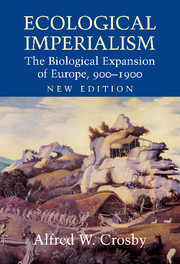
    People of European descent form the bulk of the population in most of the temperate zones of the world - North America, Australia and New Zealand. The military successes of European imperialism are easy to explain; in many cases they were a matter of firearms against spears. But, as Alfred Crosby maintains in this highly original and fascinating book, the Europeans' displacement and replacement of the native peoples in the temperate zones was more a matter of biology than of military conquest. European organisms had certain decisive advantages over their New World and Australian counterparts. The spread of European disease, flora, and fauna went hand in hand with the growth of populations. Consequently, these imperialists became proprietors of the world's most important agricultural lands. Now in a second edition with a new preface, Crosby revisits his now-classic work and again evaluates the global historical importance of European ecological expansion.

    Reviews

    ‘In telling his very readable story, Mr Crosby combines a historian’s taste for colorful detail with a scientist’s hunger for unifying and testable generalization …[He] shows that there is more to history than kings and battles, and more to ecology than fruits and nuts.’

    Source: The Wall Street Journal

    ‘Crosby argues his case with vigour, authority, and panache, summoning up examples and illustrations that are often as startling in their character as in their implications. Ecological Imperialism could not ask for a more lucid and stylish exponent.’

    Source: The Times Literary Supplement

    ‘The biological bases of radically changing historical ecosystems must never be forgotten - and Crosby has made them intelligible as well as memorable.’

    Source: Natural History

    ‘The book is important, and required reading for politicians worldwide … Nuclear war may be spectacular and a valid focus for our exertions, but ecological insouciance is even more dangerous because it is unspectacular, and it merits efforts to combat it as strenuous and urgent.’

    Source: The Guardian

    ‘Crosby has unfolded with great power the wider biopolitics of our civilization.’

    Source: Nature

    Refine List

    Actions for selected content:

    Select all | Deselect all
    • View selected items
    • Export citations
    • Download PDF (zip)
    • Save to Kindle
    • Save to Dropbox
    • Save to Google Drive

    Save Search

    You can save your searches here and later view and run them again in "My saved searches".

    Please provide a title, maximum of 40 characters.
    ×

    Contents

    Metrics

    Altmetric attention score

    Full text views

    Total number of HTML views: 0
    Total number of PDF views: 0 *
    Loading metrics...

    Book summary page views

    Total views: 0 *
    Loading metrics...

    * Views captured on Cambridge Core between #date#. This data will be updated every 24 hours.

    Usage data cannot currently be displayed.

    Accessibility standard: Unknown

    Why this information is here

    This section outlines the accessibility features of this content - including support for screen readers, full keyboard navigation and high-contrast display options. This may not be relevant for you.

    Accessibility Information

    Accessibility compliance for the PDF of this book is currently unknown and may be updated in the future.
