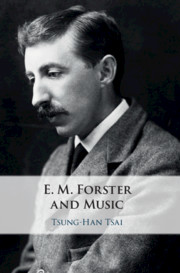

This book examines the political resonances of E. M. Forster's representations of music, offering readings of canonical and overlooked works. It reveals music's crucial role in his writing and draws attention to a previously unacknowledged eclecticism and complexity in Forster's ideological outlook. Examining unobtrusive musical allusions in a variety of Forster's writings, this book demonstrates how music provided Forster with a means of reflecting on race and epistemology, material culture and colonialism, literary heritage and national character, hero-worship and war, and gender and professionalism. It unveils how Forster's musical representations are mediated through a matrix of ideas and debates of his time, such as those about evolution, empire, Britain's relationship with the Continent, the rise of fascism, and the emergence of musicology as an academic discipline.
‘Tsung-Han Tsai’s E. M. Forster and Music offers fresh readings of Forster’s engagement with music, analysing for the first time in a single-author study Forster’s essays and short stories in addition to his longer fiction … E. M. Forster and Music, therefore, contributes both to literary scholarship of Forster’s works and word and music studies through rigorous scholarship and insightful close readings.’
Parker T. Gordon Source: Polish Journal of English Studies
'… Tsai offers a deliberately decentred book that looks across more marginal works in Forster’s oeuvre…[His] study offers so many insights by way of new contexts …'
Will May Source: Music & Letters
Loading metrics...
* Views captured on Cambridge Core between #date#. This data will be updated every 24 hours.
Usage data cannot currently be displayed.
This section outlines the accessibility features of this content - including support for screen readers, full keyboard navigation and high-contrast display options. This may not be relevant for you.
Accessibility compliance for the PDF of this book is currently unknown and may be updated in the future.
