
Skip to main content Accessibility help
×
  • Cited by 10
    • Show more authors
    • You may already have access via personal or institutional login
    • Select format
    • Publisher:
      Cambridge University Press
      Publication date:
      06 July 2023
      20 July 2023
      ISBN:
      9781009250955
      9781009250931
      Dimensions:
      (229 x 152 mm)
      Weight & Pages:
      0.564kg, 288 Pages
      Dimensions:
      Weight & Pages:
    You may already have access via personal or institutional login
  • Selected: Digital
    Add to cart View cart Buy from Cambridge.org

    Book description

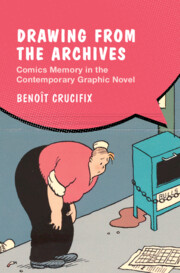
    Following Art Spiegelman's declaration that 'the future of comics is in the past,' this book considers comics memory in the contemporary North American graphic novel. Cartoonists such as Chris Ware, Seth, Charles Burns, Daniel Clowes, and others have not only produced some of the most important graphic novels, they have also turned to the history of comics as a common visual heritage to pass on to new readers. This book is a full-length study of contemporary cartoonists when they are at work as historians: it offers a detailed description of how they draw from the archives of comics history, examining the different gestures of collecting, curating, reprinting, forging, swiping, and undrawing that give shape to their engagement with the past. In recognizing these different acts of transmission, this book argues for a material and vernacular history of how comics are remembered, shared, and recirculated over time.

    Reviews

    ‘Crucifix … argues that the top notch of comic art today, perhaps some lower notches as well, has become a history machine at large. The case for comic masters as simultaneous comic historians aka archivists of the apparently obscure pulp past, is a strong one.’

    Paul Buhle Source: Comics Grinder

    ‘Crucifix's work more than fulfills the objective he sets himself … It is a very well planned, executed and organized work.’

    Enrique del Rey Cabero Source: Cuadernos de Comic

    ‘It is a compliment to [this book] that it highlights such profound issues at such a timely moment in the history of comics, I struggle to think of a book that has made me think about my drawing practice as much as it has made me think about comics history. I would therefore recommend this book as essential and deserving of the widest possible readership.’

    Gareth Brookes Source: Journal of Graphic Novels and Comics

    ‘A book with which every future study of this subject will have to reckon, building a foundation for new work in comics studies that traces the various genealogies of comics memory and transmission across the medium’s long and evolving history.’

    Matthew Levay Source: INKS

    ‘A most welcome incursion into the history of the post-2000 North American graphic novel. … Crucifix’s work achieves the objective that every monograph on the comics medium endeavors to fulfill: expanding the definition of what is encompassed by the term “comics” by bringing to light the incredibly diverse formats of the medium …’

    Élizabeth Moulin Source: Transatlantica

    ‘Benoît Crucifix’s debut book is a precious contribution to comics scholarship for several reasons: for the simplicity with which it reads despite the depth and breadth of its arguments; for the cohesion it achieves between case studies, illustrative examples,and critical reflection, always leading to one another seamlessly and often reading like a novel; and for the way it combines with acumen different critical perspectives …’

    Giorgio Busi Rizzi Source: Between: Journal of the Italian Association for the Theory and Comparative History of Literature

    ‘Crucifix's book is extremely suggestive, very well woven, and opens up new avenues of research in a field that has been scarcely explored until now.’

    Ignacio Fernández Sarasola Source: Tebeosfera

    ‘A highly innovative, diligently researched, persuasively argued, well-written, and eye-opening work of comics historiography that has much to offer for comics researchers and to readers interested in the (mainly North American) history of graphic narrative, the creation and transformation of popular archives, and ongoing negotiations of cultural value and archival valorization.’

    Daniel Stein Source: American Studies

    Refine List

    Actions for selected content:

    Select all | Deselect all
    • View selected items
    • Export citations
    • Download PDF (zip)
    • Save to Kindle
    • Save to Dropbox
    • Save to Google Drive

    Save Search

    You can save your searches here and later view and run them again in "My saved searches".

    Please provide a title, maximum of 40 characters.
    ×

    Contents

    Metrics

    Altmetric attention score

    Full text views

    Total number of HTML views: 0
    Total number of PDF views: 0 *
    Loading metrics...

    Book summary page views

    Total views: 0 *
    Loading metrics...

    * Views captured on Cambridge Core between #date#. This data will be updated every 24 hours.

    Usage data cannot currently be displayed.

    Accessibility standard: Unknown

    Why this information is here

    This section outlines the accessibility features of this content - including support for screen readers, full keyboard navigation and high-contrast display options. This may not be relevant for you.

    Accessibility Information

    Accessibility compliance for the PDF of this book is currently unknown and may be updated in the future.
