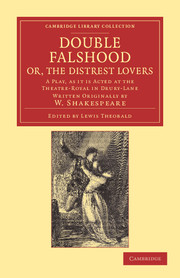
Double Falshood; or, The Distrest Lovers

-
Select format
-
- Publisher:
- Cambridge University Press
- Publication date:
- April 2013
- July 2010
- ISBN:
- 9780511736094
- 9781108019521
- Dimensions:
- Weight & Pages:
- Dimensions:
- (216 x 140 mm)
- Weight & Pages:
- 0.12kg, 86 Pages
You may already have access via personal or institutional login
Show more authors 
You may already have access via personal or institutional login
Book description
Double Falshood was staged at the Theatre Royal in Drury Lane at the end of 1727, and the following year Lewis Theobald (1688–1744) published the text, which was reprinted several times. Theobald was an energetic editor who translated Sophocles' Electra and Aristophanes' Plutus for performance in London, wrote and edited many other dramatic works, and caused great controversy in literary circles with his Shakespeare Restored (1726), a critique of Pope's edition. Scholars have debated for nearly three centuries to what extent, if at all, Double Falshood derives from a lost play by Shakespeare, as Theobald claimed. There is now widespread agreement that it is the only surviving version of Shakespeare and Fletcher's Cardenio, which was based on episodes from Cervantes' Don Quixote and is known to have been performed in 1613. Interest generated by the play's partial acceptance into the Shakespearean canon has also led to modern revivals.
Contents
Contents
Metrics
Full text views
Full text views helpTotal number of HTML views: 0
Total number of PDF views: 0 *
 Loading metrics...
* Views captured on Cambridge Core between #date#. This data will be updated every 24 hours.
Usage data cannot currently be displayed.
Accessibility standard: Unknown
Why this information is here
This section outlines the accessibility features of this content - including support for screen readers, full keyboard navigation and high-contrast display options. This may not be relevant for you.
Accessibility Information
Accessibility compliance for the PDF of this book is currently unknown and may be updated in the future.