
Skip to main content Accessibility help
×
  • Cited by 3
    • Show more authors
    • Open Access
      You have digital access to this book
    • Select format
    • Publisher:
      Cambridge University Press
      Publication date:
      03 March 2022
      10 March 2022
      ISBN:
      9781108993586
      9781108834551
      9781108995191
      Creative Commons:
      Creative Common License - CC Creative Common License - BY Creative Common License - NC Creative Common License - ND
      This content is Open Access and distributed under the terms of the Creative Commons Attribution licence CC-BY-NC-ND 4.0.
      https://creativecommons.org/creativelicenses
      Dimensions:
      (229 x 152 mm)
      Weight & Pages:
      0.6kg, 316 Pages
      Dimensions:
      (229 x 152 mm)
      Weight & Pages:
      0.426kg, 316 Pages
    Open Access
    You have digital access to this book
    Selected: Digital
    View content
    Add to cart View cart Buy from Cambridge.org

    Book description

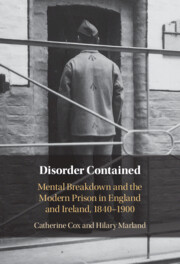
    Disorder Contained is the first historical account of the complex relationship between prison discipline and mental breakdown in England and Ireland. Between 1840 and 1900 the expansion of the modern prison system coincided with increased rates of mental disorder among prisoners, exacerbated by the introduction of regimes of isolation, deprivation and hard labour. Drawing on a range of archival and printed sources, the authors explore the links between different prison regimes and mental distress, examining the challenges faced by prison medical officers dealing with mental disorder within a system that stressed discipline and punishment and prisoners' own experiences of mental illness. The book investigates medical officers' approaches to the identification, definition, management and categorisation of mental disorder in prisons, and varied, often gendered, responses to mental breakdown among inmates. The authors also reflect on the persistence of systems of punishment that often aggravate rather than alleviate mental illness in the criminal justice system up to the current day. This title is also available as Open Access.

    Reviews

    ‘Drawing on a wide range of primary sources, this book is a fascinating contribution to historiography on British penal history. It offers a mental health lens through which to examine the penal process and is a chilling reminder that disciplinary systems that make prisoners amenable and malleable can also have serious detrimental impacts.'

    Alyson Brown - Edge Hill University

    ‘Cox and Marland bring rich expertise to this investigation of the histories of mental breakdown inside the prison system of England and Ireland. Disorder Contained points to deep tensions inherent in the treatment of mental illness inside carceral institutions still relevant in our present.'

    Catharine Coleborne - University of Newcastle (Australia)

    ‘Disorder Contained explodes the assumption that only recently have prisons come to house large numbers of people with mental illness. In this important, powerful book, Cox and Marland demonstrate that mental illness and the prison system have a long, troubled history together rooted in the nineteenth century. This is a study not just of value to historians but also for anyone interested in prison reform today.'

    Nancy Tomes - Stony Brook University

    ‘Disorder Contained is a study of impressive breadth and value, which clearly advances debates across the fields of medical, institutional, and penal history. It uses a rich vein of sources to uncover the long-standing relationship between mental illness and the prison system across both islands. In doing so, this book clearly speaks to a growing body of research from across the history of medicine and institutions, while also spotlighting the impact of mental health issues within disciplinary systems.’

    David Kilgannon Source: H-Net: Humanities and Social Science Reviews Online

    ‘a convincing - and at times disturbing - account of the effect of prison discipline on the mental health of inmates in 19th-century English and Irish prisons … Recommended.’

    P. C. Kennedy Source: Choice

    ‘… research-rich and meticulously documented … [the authors’] exhaustive use of prison records, convict files, laws, and legislation supports their rigorous discussion of whether prisoners should enter a place of instruction and probation or a place of oppressive punishment.’

    Sarah E Maier Source: Victorian Studies

    Refine List

    Actions for selected content:

    Select all | Deselect all
    • View selected items
    • Export citations
    • Download PDF (zip)
    • Save to Kindle
    • Save to Dropbox
    • Save to Google Drive

    Save Search

    You can save your searches here and later view and run them again in "My saved searches".

    Please provide a title, maximum of 40 characters.
    ×

    Contents

    Full book PDF
    • Disorder Contained
      pp i-ii
    • Copyright page
      pp iv-iv
    • Dedication
      pp v-vi
    • Contents
      pp vii-vii
    • Figures
      pp viii-viii
    • Acknowledgements
      pp ix-xii
    • 1 - Introduction
      pp 1-22
    • Mental Disorder and the Modern Prison in England and Ireland, 1840–1900
    • 2 - The Making of the Modern Prison System
      pp 23-76
    • Reformation, Separation and the Mind, 1840–1860
    • 4 - Criminal or Lunatic, Prisoner or Patient?
      pp 149-202
    • Confining Insanity in the Late Nineteenth Century
    • 6 - Conclusion
      pp 243-262
    • The Decline of the Separate System, the Prisoner Patient and Enduring Legacies
    • Bibliography
      pp 263-293
    • Index
      pp 294-304

    Metrics

    Altmetric attention score

    Full text views

    Total number of HTML views: 0
    Total number of PDF views: 0 *
    Loading metrics...

    Book summary page views

    Total views: 0 *
    Loading metrics...

    * Views captured on Cambridge Core between #date#. This data will be updated every 24 hours.

    Usage data cannot currently be displayed.

    Accessibility standard: Unknown

    Why this information is here

    This section outlines the accessibility features of this content - including support for screen readers, full keyboard navigation and high-contrast display options. This may not be relevant for you.

    Accessibility Information

    Accessibility compliance for the PDF of this book is currently unknown and may be updated in the future.
