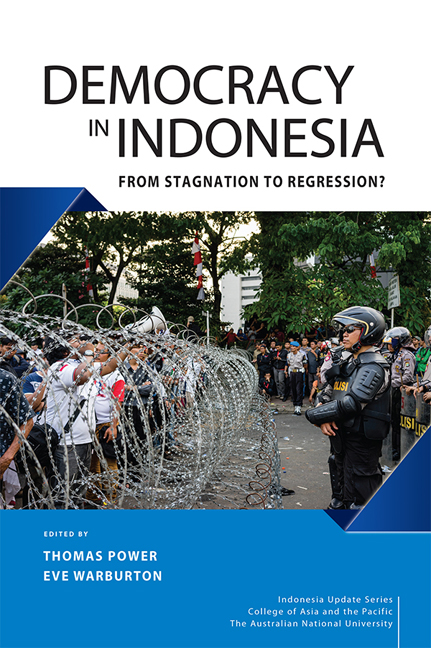
Democracy in Indonesia

-
Select format
-
- Publisher:
- ISEAS–Yusof Ishak Institute
- Publication date:
- 24 November 2020
- 19 August 2020
- ISBN:
- 9789814881524
- 9789814881517
- 9789814881500
- Dimensions:
- Weight & Pages:
- Dimensions:
- Weight & Pages:
- Series:
- Books and Monographs
Show more authors 
You may already have access via personal or institutional login
Book description
Indonesia has long been hailed as a rare case of democratic transition and persistence in an era of global democratic setbacks. But as the country enters its third decade of democracy, such laudatory assessments have become increasingly untenable. The stagnation that characterized Susilo Bambang Yudhoyono's second presidential term has given way to a more far-reaching pattern of democratic regression under his successor, Joko Widodo. This volume is the first comprehensive study of Indonesia's contemporary democratic decline. Its contributors identify, explain and debate the signs of regression, including arbitrary state crackdowns on freedom of speech and organization, the rise of vigilantism, deepening political polarization, populist mobilization, the dysfunction of key democratic institutions, and the erosion of checks and balances on executive power. They ask why Indonesia, until recently considered a beacon of democratic exceptionalism, increasingly conforms to the global pattern of democracy in retreat.
Contents
Contents
Metrics
Full text views
Full text views helpTotal number of HTML views: 0
Total number of PDF views: 0 *
 Loading metrics...
* Views captured on Cambridge Core between #date#. This data will be updated every 24 hours.
Usage data cannot currently be displayed.
Accessibility standard: Unknown
Why this information is here
This section outlines the accessibility features of this content - including support for screen readers, full keyboard navigation and high-contrast display options. This may not be relevant for you.
Accessibility Information
Accessibility compliance for the PDF of this book is currently unknown and may be updated in the future.