The Dancing Body in Renaissance Choreography

-
Select format
-
- Publisher:
- Anthem Press
- Publication date:
- 13 May 2022
- 01 March 2022
- ISBN:
- 9781785278020
- 9781785278013
- Dimensions:
- Weight & Pages:
- Dimensions:
- Weight & Pages:
You may already have access via personal or institutional login
Show more authors 
You may already have access via personal or institutional login
Book description
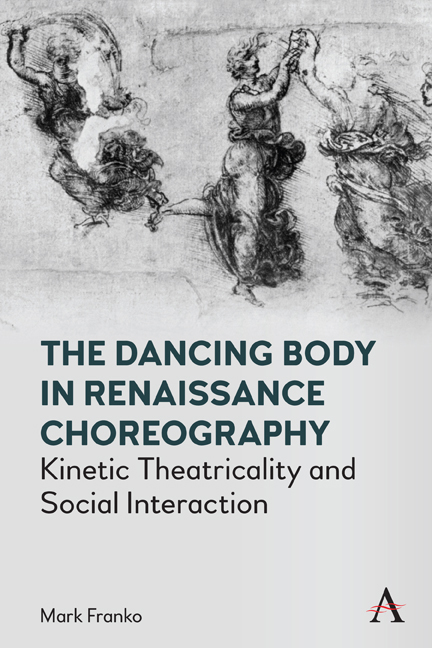
Renaissance dance treatises claim that the dance is a language but do not explain how or what dancing communicates. Since the body is the instrument of this hypothetical language, The Dancing Body in Renaissance Choreography problematizes the absence of the dancing body in treatises in order to reconstruct it through a series of intertextual readings triggered by Thoinot Arbeau’s definition of dance as a mute rhetoric in Orchésographie. This book shows that the oratorical model for Arbeau’s definition of the dance is epideictic and that although one cannot equate dance and oratorical action, the ends of oratorical action are those of dance: persuasion through charm and emotion.
Contents
Contents
Metrics
Full text views
Full text views helpTotal number of HTML views: 0
Total number of PDF views: 0 *
 Loading metrics...
* Views captured on Cambridge Core between #date#. This data will be updated every 24 hours.
Usage data cannot currently be displayed.
Accessibility standard: Unknown
Why this information is here
This section outlines the accessibility features of this content - including support for screen readers, full keyboard navigation and high-contrast display options. This may not be relevant for you.
Accessibility Information
Accessibility compliance for the PDF of this book is currently unknown and may be updated in the future.