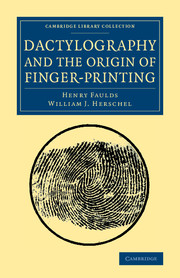

The Scottish doctor Henry Faulds (1843–1930) and the English judge Sir William James Herschel (1833–1917) both recognised the potential of fingerprints as a means of identification. While working in Japan, Faulds had developed his methods after noticing impressions on ancient pottery. Herschel, during his service as a magistrate in India, had introduced a system of using fingerprints as a way of preventing fraud. In the course of a lengthy controversy, Faulds sought to be acknowledged for the significance of his discoveries. Although there is no doubt that Faulds was first to publish on the subject, it was Herschel's work, begun in the 1850s, which was later developed by Galton and Henry as the tool of forensic science we know today. Reissued here together, these two works, first published in 1912 and 1916 respectively, are Faulds' overview of the subject and Herschel's account of his work in India.
Loading metrics...
* Views captured on Cambridge Core between #date#. This data will be updated every 24 hours.
Usage data cannot currently be displayed.
This section outlines the accessibility features of this content - including support for screen readers, full keyboard navigation and high-contrast display options. This may not be relevant for you.
Accessibility compliance for the PDF of this book is currently unknown and may be updated in the future.
