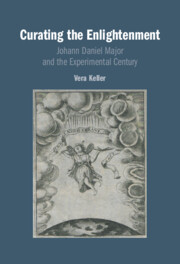
Curating the Enlightenment

-
Select format
-
- Publisher:
- Cambridge University Press
- Publication date:
- December 2024
- November 2024
- ISBN:
- 9781009506854
- 9781009506830
- Dimensions:
- (229 x 152 mm)
- Weight & Pages:
- 0.74kg, 414 Pages
- Dimensions:
- Weight & Pages:
You may already have access via personal or institutional login
Show more authors 
You may already have access via personal or institutional login
Book description
How did the research universities of the Enlightenment come into being? And what debt do they owe to scholars of the previous era? Focusing on the career of German polymath Johann Daniel Major (1634–93), Curating the Enlightenment uncovers how late seventeenth-century scholars crafted the research university as a haven for critical inquiry in defiance of political and economic pressures. Abandoning the surety of established intellectual practice, this 'experimental century' saw Major and his peers reshaping fragments of knowledge into new perspectives. Across new disciplines, from experimental philosophy to archaeology and museology, they reexamined what knowledge was, who it was for, and how it was to be stored, managed, accessed, judged, and transformed. Although later typecast as Baroque obstacles to be overcome by the Enlightenment, these academics arranged knowledge in dynamic infrastructures that encouraged its further advancement in later generations, including our own. This study examines these seventeenth-century practices as part of a continuous intellectual tradition and reconceptualizes our understanding of the Enlightenment.
Awards
Short-listed, 2025 Pfizer Award, History of Science Society
Reviews
‘Keller is a masterful guide through the thickets of late 17th-century German academic culture and its colorful characters, collections, and publications. She traces the origins of research to this lost world, where curiosity and freedom from external interference allowed a shifting set of disciplines to form and in ways that proved seminal to the Enlightenment.’
Ann Blair - Harvard University
‘This is a bold, eye-opening book that debunks long-held prejudices about pedantic ‘baroque’ scholarship and the backwardness of 17th-century German science. Instead, it tells a whole new story: that of the ‘experimental century’, in which new, fluid changes are made in the knowledge system, and in which there is no contradiction between corpuscular physics, museum facilities and extensive citation practices.’
Martin Mulsow - University of Erfurt
‘… a major accomplishment of intellectual history.… Recommended.’
J. T. Rosenthal Source: CHOICE
Contents
Contents
Metrics
Full text views
Full text views helpTotal number of HTML views: 0
Total number of PDF views: 0 *
 Loading metrics...
* Views captured on Cambridge Core between #date#. This data will be updated every 24 hours.
Usage data cannot currently be displayed.
Accessibility standard: Unknown
Why this information is here
This section outlines the accessibility features of this content - including support for screen readers, full keyboard navigation and high-contrast display options. This may not be relevant for you.
Accessibility Information
Accessibility compliance for the PDF of this book is currently unknown and may be updated in the future.