
Skip to main content Accessibility help
×
  • Cited by 2
    • Show more authors
    • You may already have access via personal or institutional login
    • Select format
    • Publisher:
      Cambridge University Press
      Publication date:
      November 2023
      November 2023
      ISBN:
      9781009327060
      9781009327084
      9781009327046
      Dimensions:
      (229 x 152 mm)
      Weight & Pages:
      0.449kg, 194 Pages
      Dimensions:
      (229 x 152 mm)
      Weight & Pages:
      0.25kg, 194 Pages
    You may already have access via personal or institutional login
  • Selected: Digital
    Add to cart View cart Buy from Cambridge.org

    Book description

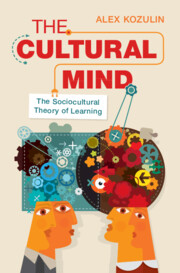
    Drawing attention to the pivotal ideas associated with 'the science of the cultural mind', this book centres on the idea that the human mind should be considered a sociocultural, rather than a natural or biological, phenomenon. Far from being purely theoretical, the science of the cultural mind has direct, practical implications for areas such as child development, the assessment of learning processes, and future-oriented education. The chapters are organized around five pivotal ideas and their applications, including mediated learning, symbolic tools, and leading activity. It also provides a systematic review of the Vygotskian theory and its contemporary implications in cognitive development. Written in an accessible and engaging style, this book contains examples of practical applications of the sociocultural theory of learning that will benefit students, researchers, and practitioners in child development, educational psychology, culture studies, and education.

    Awards

    Winner, 2025 Book Award, Society of Professors of Education

    Reviews

    ‘A landmark work that, for the first time, comprehensively presents the sociocultural approach to learning and synthesizes compelling evidence for it as key to optimizing education and human development in contemporary times. Alex Kozulin persuasively argues for a transformation in current educational practice as an urgent priority, from transmission of static knowledge and skills to ‘learning how to learn’. Beyond that, this text is unique in clarifying the theoretical ideas and evidence-based teaching and assessment strategies essential for attaining this goal. Masterfully crafted, rich in research findings and practical examples, this book is an essential read for researchers and educators alike. A wonderful volume by a leading sociocultural theorist, investigator, and talented author that promises to have a major impact for years to come.’

    Laura E. Berk - Distinguished Professor of Psychology Emerita, Illinois State University

    ‘The originality of Alex Kozulin’s new book relates to the fact that the sociocultural theory is presented as a set of interconnected key concepts. Each concept, in turn, is discussed in its development from the original idea to its further elaboration and practical implementation.’

    Yuriy Karpov - Professor of Psychology and Education, Touro University

    ‘Written by a renowned authority on Vygotsky’s account of consciousness and its development, this latest work offers both an accessible synthesis of the theory’s central principles and an illustration of their relevance to education, with examples from diverse populations and across academic disciplines. A must-read!’

    Matthew E. Poehner - Professor of Education and Applied Linguistics, Pennsylvania State University

    ‘Alex Kozulin is one of the pioneers of Vygotsky Studies as a translator and the author of the first whole-book intellectual biography of Lev Vygotsky. In his new book, Kozulin presents a creative ‘reconstruction’ of classical Vygotskian legacy, enhanced and rethought in the tradition of Reuven Feuerstein, and produces an exciting new synthesis in educational theory and practice for the 21st century.’

    Anton Yasnitsky - author of Vygotsky: An Intellectual Biography

    ‘Alex Kozulin's advocacy for integrating socio-cultural theory's theoretical components into a comprehensive approach to human learning, particularly in the digital age, is not just timely, but also highly relevant, keeping educators, researchers, and individuals interested in sociocultural theory and contemporary education well-informed and up-to-date.’

    Boris Gindis - Director and Chief Psychologist, Center for Cognitive-Developmental Assessment and Remediation

    ‘Recommended.’

    J. A. Reyhner Source: CHOICE

    Refine List

    Actions for selected content:

    Select all | Deselect all
    • View selected items
    • Export citations
    • Download PDF (zip)
    • Save to Kindle
    • Save to Dropbox
    • Save to Google Drive

    Save Search

    You can save your searches here and later view and run them again in "My saved searches".

    Please provide a title, maximum of 40 characters.
    ×

    Contents

    Metrics

    Altmetric attention score

    Full text views

    Total number of HTML views: 0
    Total number of PDF views: 0 *
    Loading metrics...

    Book summary page views

    Total views: 0 *
    Loading metrics...

    * Views captured on Cambridge Core between #date#. This data will be updated every 24 hours.

    Usage data cannot currently be displayed.

    Accessibility standard: Unknown

    Why this information is here

    This section outlines the accessibility features of this content - including support for screen readers, full keyboard navigation and high-contrast display options. This may not be relevant for you.

    Accessibility Information

    Accessibility compliance for the PDF of this book is currently unknown and may be updated in the future.
